Illumination / Light Source Failure
Microscope illumination fails to start, becomes too dim, or is uneven. Documented causes include failed or aging xenon/LED sources, defective light guides, disconnected illumination modules, and power faults.

Acme Revival is an independent repair network that operates separately from the manufacturers whose devices we service. Our independence enables a repair model that exists beyond manufacturer-controlled strategies, while preserving the ability to work with manufacturers where appropriate.
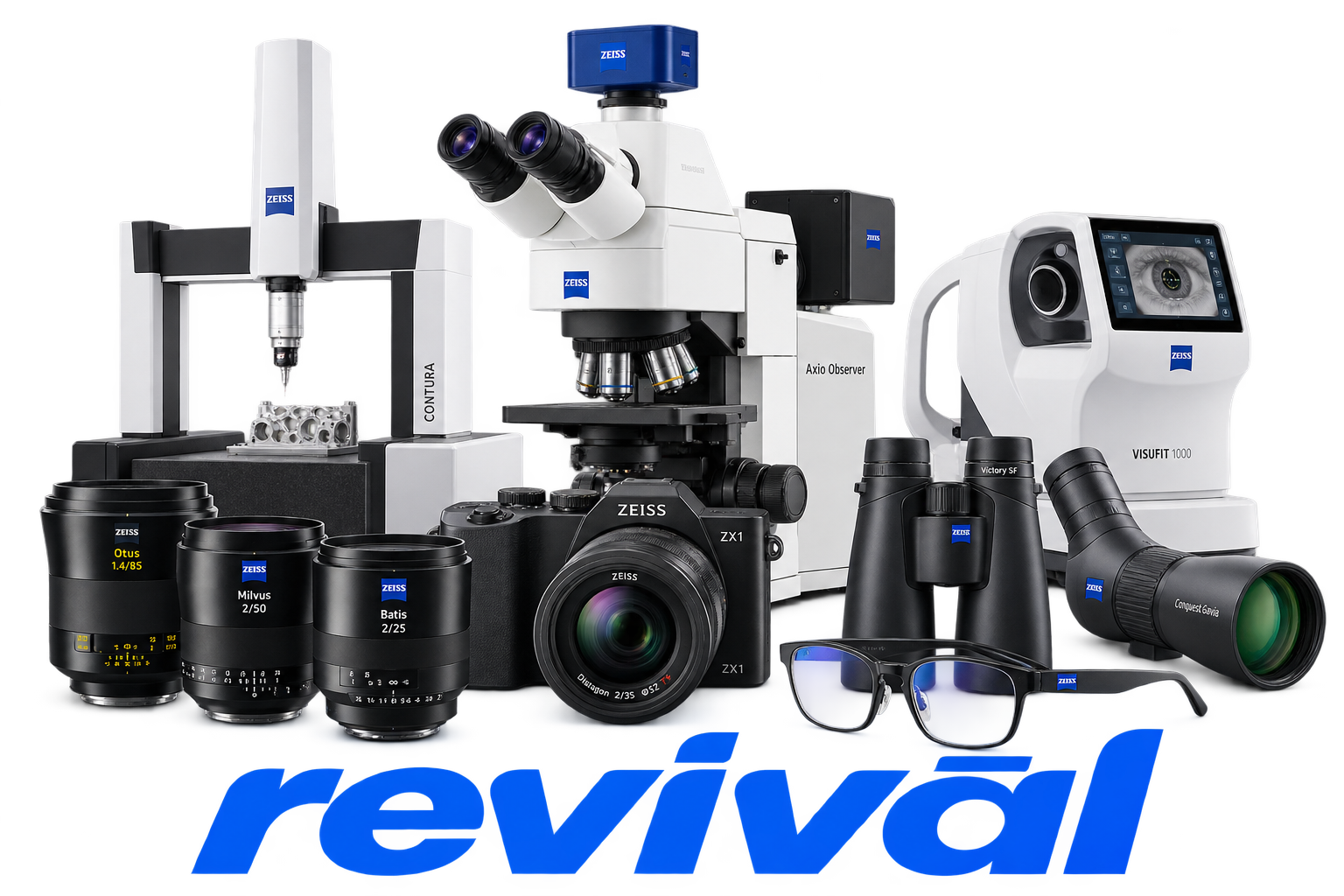
Carl Zeiss AG (ZEISS) is a global optics and optoelectronics technology manufacturer known for extremely high-precision optical systems and components. Its businesses span semiconductor manufacturing technology, industrial metrology and microscopy, medical technology, vision care, and specialized optical products. ZEISS develops and manufactures lithography optics used in semiconductor production, coordinate measuring and inspection systems, optical/electron/X-ray microscopes, ophthalmology and microsurgery equipment, eyeglass lenses, camera and cinematography lenses, binoculars, and customized OEM optical and optoelectronic components, modules, and systems. The company is particularly known for its advanced lithography optics used in microchip manufacturing; semiconductor manufacturing is currently its largest business segment, generating approximately €5.1B of FY2024/25 revenue.
Microscope illumination fails to start, becomes too dim, or is uneven. Documented causes include failed or aging xenon/LED sources, defective light guides, disconnected illumination modules, and power faults.
The instrument fails to power on or becomes completely nonfunctional. Common documented causes include faulty power units, interrupted mains power, loose power connections, and triggered circuit breakers.
Dust, oil, liquids, or other contamination on objectives, condensers, eyepieces, sensors, or other optical surfaces causes poor contrast, artifacts, or reduced resolution. Objective front lenses and other surfaces in the image-forming path are particularly important contamination points.
The microscope cannot achieve or maintain correct focus, or the microscope mount moves downward unexpectedly. Causes include improperly adjusted focusing drives, control-system faults, incorrect Z-axis configuration, and mechanical adjustment problems.
Motorized XY stages fail initialization or stop at an incorrect position. ZEISS documentation identifies stage-initialization failures that may persist after restart and require service intervention.
One side of the field appears sharp while another remains blurred or overall resolving power deteriorates. Typical causes include condenser misalignment, improperly engaged nosepieces, incorrectly mounted objectives, poorly secured specimens, or contaminated optics.
Connected imaging hardware produces no image, flickering video, or otherwise unusable output. Documented causes include camera-control-unit power problems, incorrect video configuration, connection failures, and associated electronics issues.
Images exhibit focus differences between objectives or fail to focus correctly after objective changes. Common causes include objectives not fully seated, nosepieces failing to lock into position, incorrect tube-lens configuration, and mismatched system configuration.
Hardware functions such as focusing or illumination stop responding to handgrips, foot controls, or other electronic controls. ZEISS manuals identify system-control and stand-electronics failures as causes that can require manual fallback operation and professional service.
Connect with a technician.

Orders can typically be cancelled 24 hours prior to shipping
Get a real-time offer. Enter the make and model to begin.
Acme offers several ways to pay your service or repair balance.
Securely powered by 
This service is provided by Community Federal Savings Bank (“CFSB”), member FDIC, for which GoCardless Ltd acts as a third-party servicer.
Payable to ACME REVIVAL INC, write Zeiss in memo line, and mail your check to: 191 University Blvd. Suite 340, Denver, CO 80206. Payment are collected every weekday excluding federal holidays.