Display Failure or Flickering
LCD/OLED displays may flicker, lose contrast, show intermittent characters, or go completely blank. On legacy Axe-Fx units, a loose or oxidized display ribbon-cable connection is a frequently reported cause.

Acme Revival is an independent repair network that operates separately from the manufacturers whose devices we service. Our independence enables a repair model that exists beyond manufacturer-controlled strategies, while preserving the ability to work with manufacturers where appropriate.
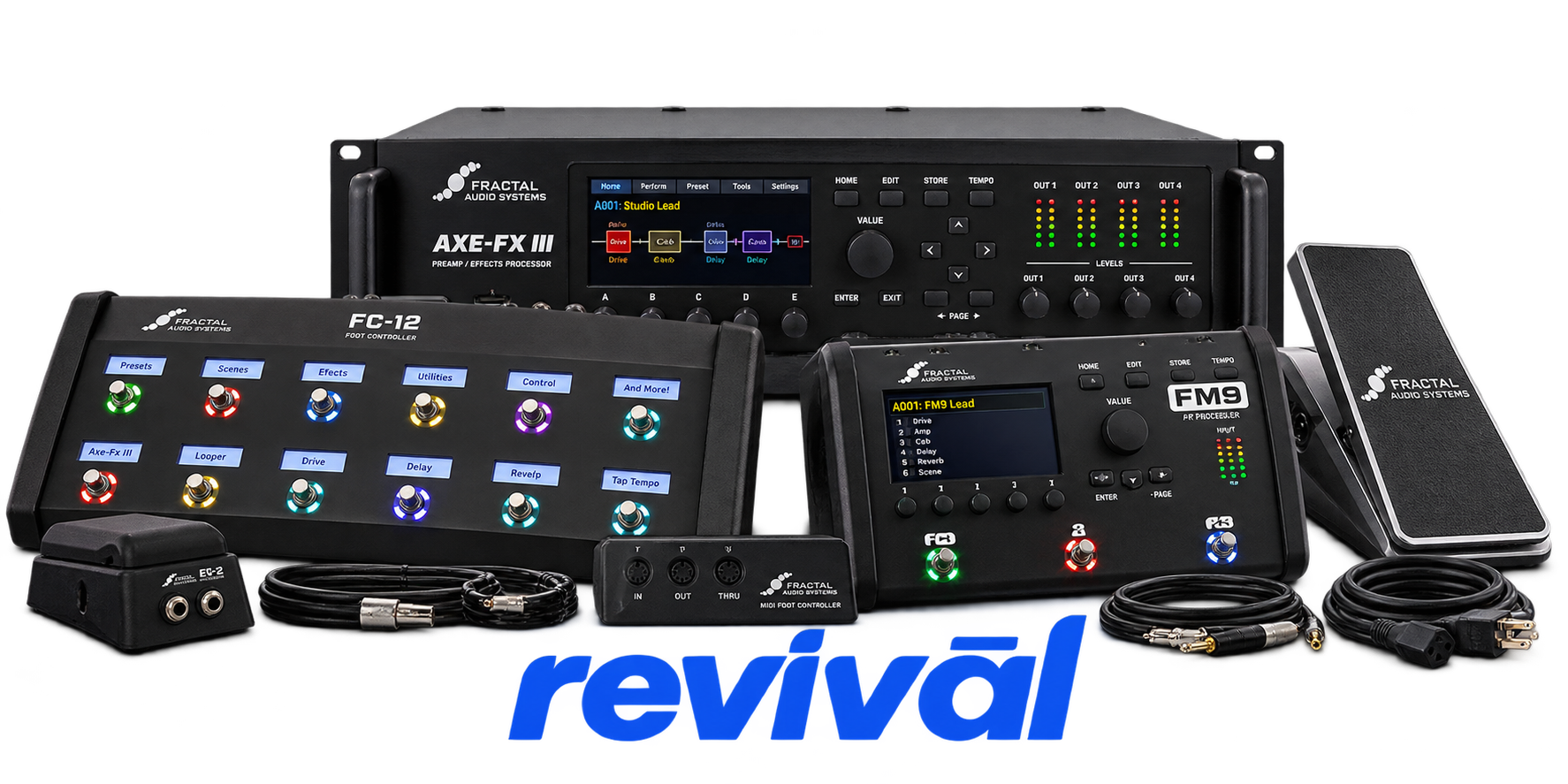
Fractal Audio Systems, LLC is a U.S. professional-audio manufacturer founded in 2006 and best known for high-end digital guitar amp modeling, speaker simulation, effects processing, and performance-control hardware. Its flagship Axe-Fx platform established the company in the professional guitar-processing market, while current products include the Axe-Fx III, FM9, FM3, VP4, AM4, and FC foot controllers. Its processors combine proprietary amplifier-modeling algorithms, cabinet impulse-response technology, studio and stompbox effects, extensive routing, USB audio, and powerful DSP hardware for live performance and recording. Fractal positions its products primarily toward guitarists who want detailed reproduction of tube amplifiers, speaker cabinets, and effects without relying on traditional physical amp rigs, and its equipment is used by both touring professionals and home/studio musicians.
LCD/OLED displays may flicker, lose contrast, show intermittent characters, or go completely blank. On legacy Axe-Fx units, a loose or oxidized display ribbon-cable connection is a frequently reported cause.
Axe-Fx, FM3, and FM9 units can develop intermittent USB detection, dropped connections, failed enumeration, or loss of USB audio/editor communication. After eliminating cables, drivers, and firmware, faults can involve the USB connector, solder joints, protection circuitry, or USB-controller hardware.
FM3, FM9, FC-6, and FC-12 switches may intermittently fail to register presses, remain stuck in one state, or behave incorrectly after startup. Persistent cases can originate in the switch sensing electronics, wiring, or associated control circuitry.
Units may become completely dead, shut down unexpectedly, reboot, or fail to complete startup when internal power-supply components deteriorate. Power regulation, internal fuses, connectors, and aging PSU components are typical hardware areas requiring diagnosis.
VALUE and parameter encoders can begin skipping values, moving in the wrong direction, responding erratically, or failing to register turns or presses. Wear, contamination, damaged encoder contacts, or front-panel PCB connections are common causes in heavily used equipment.
Older Axe-Fx hardware can develop a low internal battery, causing stored system information or settings to become unreliable. Replacement of the coin-cell battery is a documented maintenance repair on aging units.
Legacy Axe-Fx and Axe-Fx II units can fail to boot because of corrupted or failed EPROM/flash memory. Symptoms include hanging during startup, blank or frozen displays, and units requiring emergency firmware recovery or replacement boot memory.
Rackmount Axe-Fx models have generated repeated reports of noisy, whining, vibrating, or deteriorating cooling fans, particularly among older Axe-Fx II units. A worn fan bearing or failed fan can reduce airflow and may require fan replacement.
Instrument inputs, balanced outputs, headphone outputs, and other physical I/O can become intermittent or lose signal through worn connectors, cracked solder joints, damaged switching contacts, or nearby analog circuitry. Symptoms commonly include channel dropouts, crackling when connectors move, or otherwise normal processing with no usable input or output.
Connect with a technician.

Orders can typically be cancelled 24 hours prior to shipping
Get a real-time offer. Enter the make and model to begin.
Acme offers several ways to pay your service or repair balance.
Securely powered by 
This service is provided by Community Federal Savings Bank (“CFSB”), member FDIC, for which GoCardless Ltd acts as a third-party servicer.
Payable to ACME REVIVAL INC, write Fractal Audio in memo line, and mail your check to: 191 University Blvd. Suite 340, Denver, CO 80206. Payment are collected every weekday excluding federal holidays.