Card Feed Failure
Cards fail to enter the printing mechanism or feed intermittently. Common causes include worn or dirty feed rollers, incorrect card-thickness settings, static, stuck cards, or feeder wear.

Acme Revival is an independent repair network that operates separately from the manufacturers whose devices we service. Our independence enables a repair model that exists beyond manufacturer-controlled strategies, while preserving the ability to work with manufacturers where appropriate.
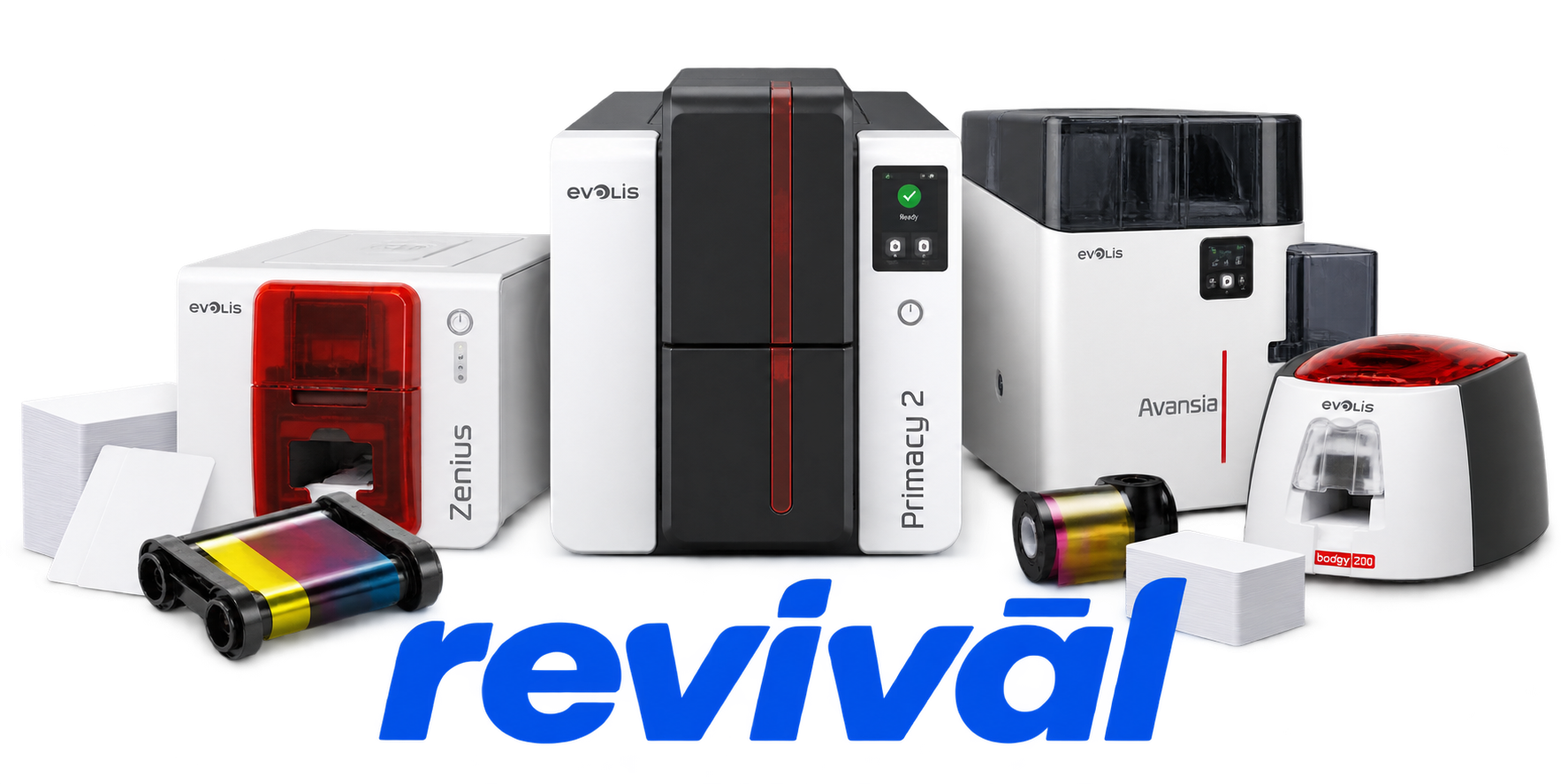
Evolis is a French OEM specializing in card personalization and identification systems, particularly desktop and industrial printers used to print, encode, and issue plastic and identification cards. The company designs and manufactures its card-personalization solutions at its factory in Beaucouzé, France, and offers direct-to-card and retransfer printers, card encoders, laminating systems, consumables/ribbons, personalization software, signature pads, and identification accessories. Its equipment is used for employee and access-control badges, payment and banking cards, student IDs, transportation cards, loyalty cards, government IDs, event credentials, and similar applications. Evolis describes itself as the global leader in decentralized card issuance; it has more than 450,000 printers installed, sells through roughly 3,000 partners in 140 countries, and manufactured 58,317 printers in 2025. Evolis
Cards fail to enter the printing mechanism or feed intermittently. Common causes include worn or dirty feed rollers, incorrect card-thickness settings, static, stuck cards, or feeder wear.
Cards become stuck while traveling through the printer, causing a mechanical error and stopping the print job. Jams are frequently associated with dirty rollers, incorrect card thickness, warped or adhering cards, transport components, or card-path sensor issues.
A dirty, worn, or damaged thermal printhead produces horizontal white lines, missing portions of images, blank cards, or consistently poor output. Physical contamination and incompatible or dirty card stock can accelerate printhead damage.
The ribbon tears, wrinkles, fails to advance, or cannot be correctly wound through the printing mechanism. Incorrect ribbon installation, synchronization, excessive heat or print settings, dirty transport components, and mechanical ribbon-drive problems can cause recurring failures.
Cards show faded areas, spots, blurred images, color inconsistencies, white lines, or incomplete printing. Dirty cleaning rollers or printheads, contaminated cards, wrinkled ribbons, incompatible card stock, and incorrect transfer or print settings are common causes.
Duplex-capable printers can fail while reversing or repositioning a card for printing on the second side. Miscalibration, dirty transport components, card jams, sensor problems, or faults in the flip mechanism can prevent the card from completing its path.
The printer fails to write, read, or verify data on a magnetic-stripe card. Incorrect card orientation, damaged stripes, HiCo/LoCo configuration mismatches, improperly formatted data, or encoder hardware problems are common causes.
Retransfer models such as Avansia can fail to recognize, feed, or wind the transfer film, sometimes producing film wind-up or invalid-film errors. Torn film, dirty feed rollers, cassette problems, sensor faults, or transfer-film drive problems can interrupt printing.
The printer stops responding to the host computer or print jobs remain stalled despite the printer being powered. Loose or damaged USB connections, interface faults, driver or firmware problems, stuck print queues, or printer electronics can cause loss of communication.
Connect with a technician.

Orders can typically be cancelled 24 hours prior to shipping
Get a real-time offer. Enter the make and model to begin.
Acme offers several ways to pay your service or repair balance.
Securely powered by 
This service is provided by Community Federal Savings Bank (“CFSB”), member FDIC, for which GoCardless Ltd acts as a third-party servicer.
Payable to ACME REVIVAL INC, write Evolis in memo line, and mail your check to: 191 University Blvd. Suite 340, Denver, CO 80206. Payment are collected every weekday excluding federal holidays.