Grinding Chamber Blockage
Coffee grounds, oily beans, foreign objects, or grinding too finely can jam the grinding chamber and prevent the burrs from rotating. Hardened grounds after extended periods without cleaning are also a documented cause.

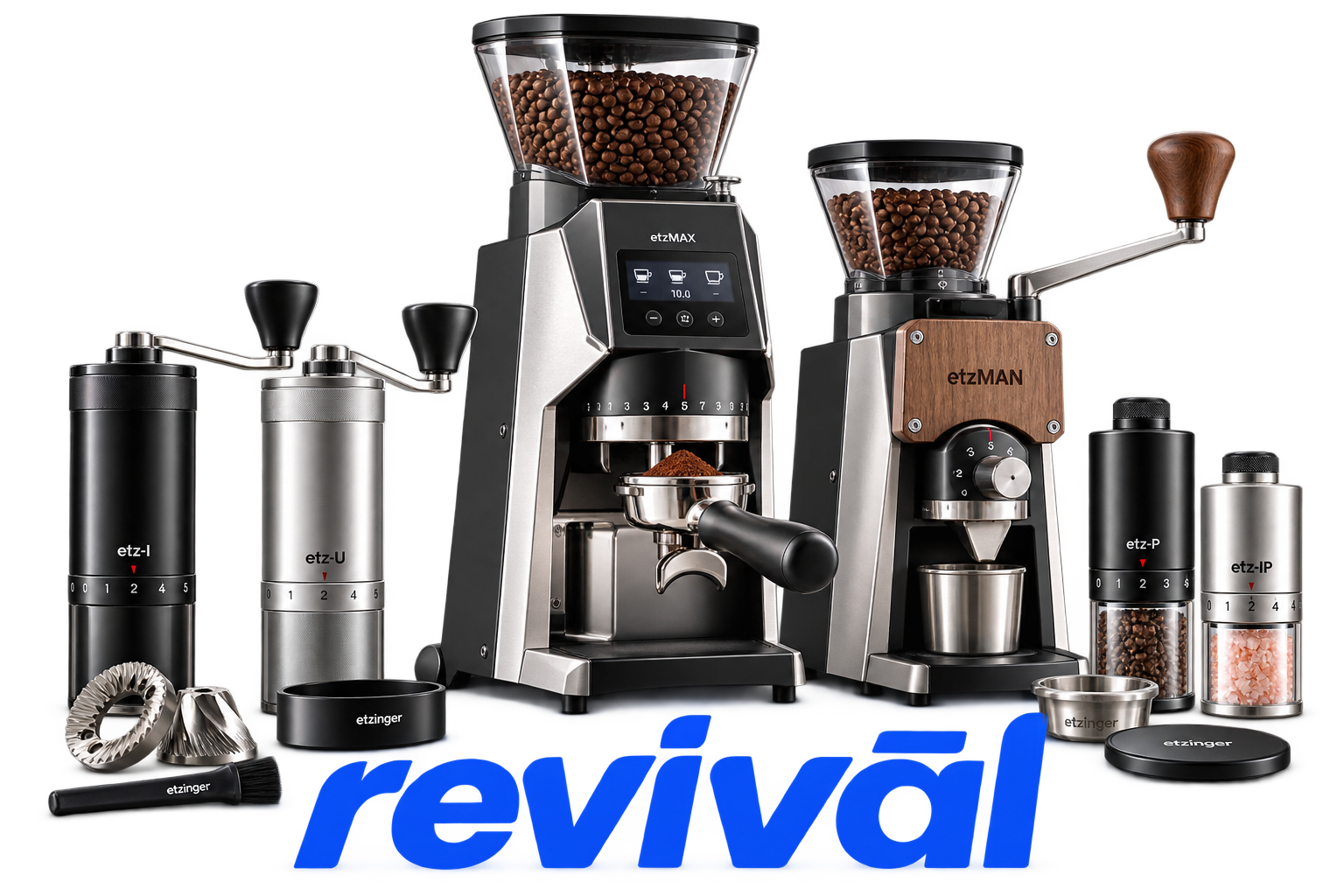
Acme Revival is an independent repair network that operates separately from the manufacturers whose devices we service. Our independence enables a repair model that exists beyond manufacturer-controlled strategies, while preserving the ability to work with manufacturers where appropriate.
Etzinger AG is a Liechtenstein-based precision grinding-technology OEM founded and led by aeronautical engineer Christian Etzinger. The company specializes in designing and manufacturing high-precision conical burr sets and grinding mechanisms, along with complete electric and manual coffee grinders and pepper/spice mills. Its core manufacturing competency is highly automated production of precision burrs in Liechtenstein, with stated capacity exceeding 1 million burr sets annually. Etzinger supplies grinding components for other appliance manufacturers as well as selling its own products, including the etzMAX commercial electric grinder and etz-I manual grinder. The company is particularly known for its proprietary burr geometry, automated precision manufacturing, and rotating-ring-burr grinding technology; current industry reporting also identifies it as the exclusive burr supplier for certain Sage/Breville appliances.
Coffee grounds, oily beans, foreign objects, or grinding too finely can jam the grinding chamber and prevent the burrs from rotating. Hardened grounds after extended periods without cleaning are also a documented cause.
The etzMAX protection switch can repeatedly trip when the grinder is blocked, operated at excessively fine settings, fitted with a worn coneholder, or run beyond its recommended duty cycle. The grinder may stop completely until the underlying obstruction or overload is corrected.
The etzMAX motor can overheat and shut down when maximum operating cycles are exceeded or when difficult beans and fine settings create excessive load. Continued overheating can contribute to eventual motor or etzJET failure.
Coneholders, particularly older plastic versions, wear over time and can cause grind inconsistency, blockages, drive-system problems, or damage elsewhere in the grinder. Etzinger specifically recommends replacing worn coneholders and introduced metal versions to address wear-related issues.
The grind adjustment can become difficult or impossible to turn because of trapped coffee, incorrect reassembly, clogging, or operation outside the recommended grind range. Extremely coarse settings can also contribute to damage of the etzMAX micro/macro adjustment mechanism.
The selected grind size may produce unexpectedly faster or slower extraction when the coneholder is worn, incorrectly seated, or contaminated with trapped coffee. On etz-I/etz-U grinders, the adjustment ring can also move if it is contacted or held incorrectly during grinding.
Weight-based etzMAX models can produce inaccurate doses or error codes when affected by vibration, unsuitable containers, contact with the grinder housing, static, or calibration problems. Load-cell sensitivity can require recalibration or, in hardware-failure cases, replacement.
A damaged or broken microswitch can leave the etzMAX display and timer functioning while the motor itself fails to start. Microswitch damage can also occur during incorrect reassembly of the adjustment mechanism.
The etz-I anti-static mechanism can retain a small compressed quantity of grounds in the grinding chamber, while environmental conditions and coffee characteristics can still produce static on Etzinger grinders. Accumulated retained grounds can affect cleanliness and consistency and, if allowed to harden, contribute to blockage.
Connect with a technician.

Orders can typically be cancelled 24 hours prior to shipping
Get a real-time offer. Enter the make and model to begin.
Acme offers several ways to pay your service or repair balance.
Securely powered by 
This service is provided by Community Federal Savings Bank (“CFSB”), member FDIC, for which GoCardless Ltd acts as a third-party servicer.
Payable to ACME REVIVAL INC, write Etzinger in memo line, and mail your check to: 191 University Blvd. Suite 340, Denver, CO 80206. Payment are collected every weekday excluding federal holidays.