
ETC

Repair, Service, and Parts

ETC repair, service, and parts

Acme Revival is an independent repair network that operates separately from the manufacturers whose devices we service. Our independence enables a repair model that exists beyond manufacturer-controlled strategies, while preserving the ability to work with manufacturers where appropriate.

Middleton and Mazomanie, Dane County, Wisconsin, USA
Manuf. Location
≈ US $452M
Annual Revenue (est)
Entertainment lighting
End Use Segment

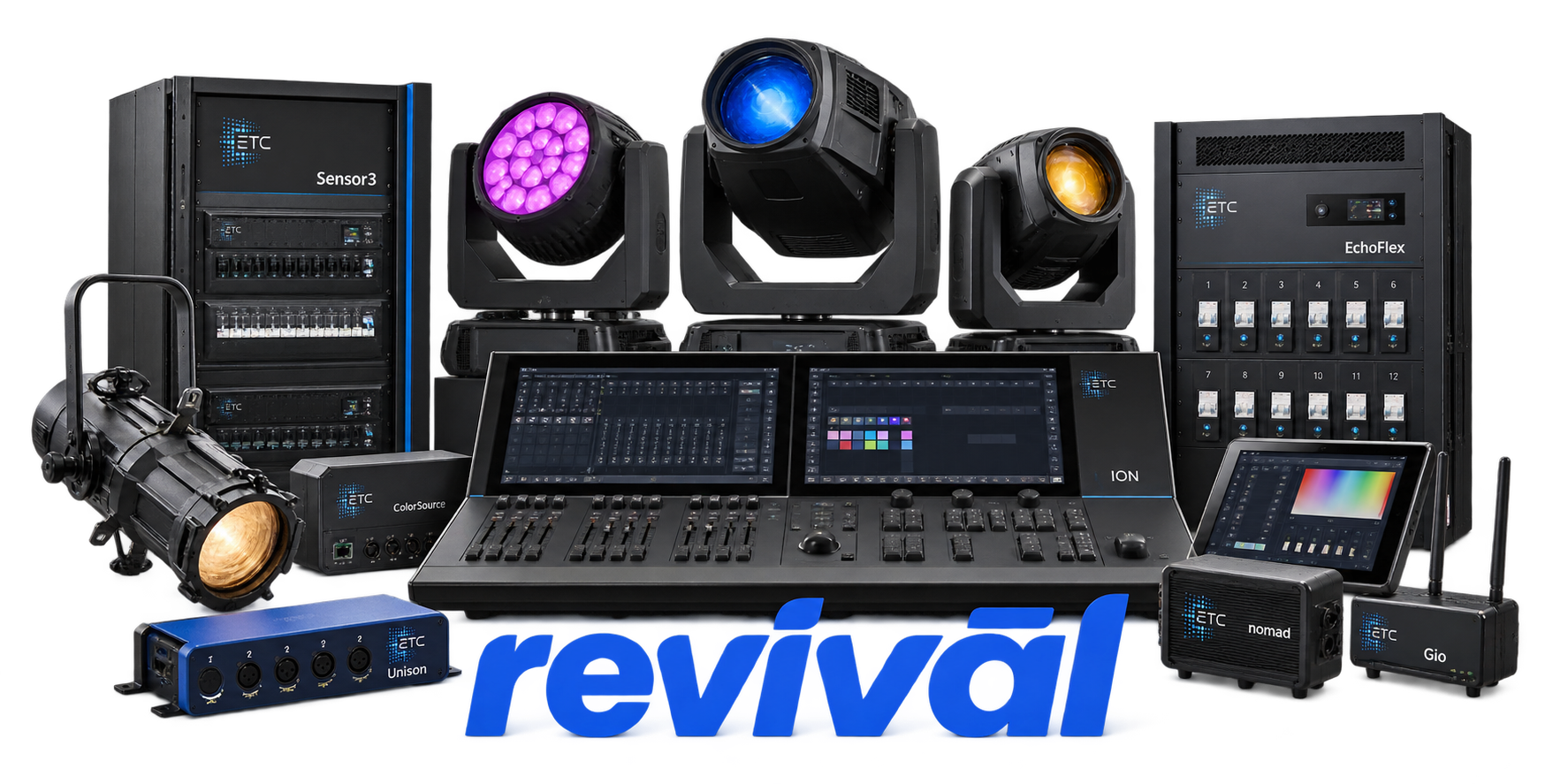
Electronic Theatre Controls, Inc., commonly known as ETC, is a U.S. manufacturer specializing in professional entertainment and architectural lighting technology. Founded in 1975, the company is particularly well known for its Eos-family lighting control consoles, Source Four theatrical fixtures, LED and automated luminaires, dimming and power-control systems, architectural lighting controls, networking and DMX infrastructure, power/data distribution equipment, and motorized theatrical rigging systems. Its equipment is widely used in theatres, performing-arts venues, concert and live-event spaces, television and film studios, schools, houses of worship, museums, theme parks, arenas, and architectural installations. ETC describes itself as an international leader in event-lighting technology, covering everything from lighting fixtures and control consoles to architectural systems and stage-rigging hoists.

2 Most Seen Failures:

Power Supply Failure

ETC consoles and LED fixtures can develop failed or unstable power supplies, causing no-power, flashing indicators, intermittent resets, or failure to boot. Ion documentation specifically identifies a bad PSU when the console is completely unresponsive or repeatedly flashes its LCD and LEDs.


Fader Potentiometer Failure

Element and other ETC console faders can become erratic, jittery, intermittent, or fail to register movement because the fader potentiometer has worn or failed. A defective pot can sometimes interfere with the behavior of an adjacent fader as well.

Dimmer Output Circuit Failure

Sensor and related dimming systems can lose individual channels or entire banks because of failed output-control ICs, damaged pins, broken solder joints, shorts, or buffer IC failure. The typical symptom is one or more circuits receiving control commands but producing no load output.

Cooling Fan Failure

Failed fans, blown fan fuses, or defective fan-sense circuitry are recurring faults in ETC dimming racks and LED fixtures. Loss of cooling can trigger Fan Fail or overtemperature errors and may ultimately shut down fixture or dimmer output.

Overtemperature / Thermal Shutdown

Sensor dimmer modules and Source Four LED-family fixtures can shut down, cycle off and back on, or report overtemperature conditions when cooling is inadequate or a module develops a thermal problem. Faulty fans, obstructed ventilation, and deteriorating dimmer hardware can all contribute.

DMX Receiver / Input Failure

Source Four LED fixtures can stop responding to otherwise valid DMX, flicker, or intermittently drop out when the onboard DMX receiver chip or input circuitry fails. ETC specifically documents replacement of the DMX transceiver when cabling and the upstream DMX source have been ruled out.

Hard Drive / Boot Storage Failure

Older Ion and related Eos-family consoles can stall at the splash screen or fail to complete startup when their internal hard drive or boot storage fails. Re-imaging may recover software corruption, while an actual drive failure requires hardware replacement.

LED Array / Driver System Failure

Source Four LED and Desire-family fixtures can produce no light, incorrect colors, restricted colors, or a Color System Fail condition when the LED array, driver electronics, array memory, or connecting cables fail. Loss of calibration data or failed array memory can require factory-level repair or recalibration.

Low-Voltage Control Power Failure

ETC architectural systems such as Unison, Paradigm, and DRd can develop dead processors, blank touchscreens, or unresponsive control stations when their low-voltage supply, regulator, fuse, dimming engine, or station-power circuitry fails. The failure may disable a single station or an entire architectural-control network.

1 Acme Revival offers repair, service, and part rebuild opportunities for most ETC devices.

Connect with a technician.

  1. 1 Repairs are performed on a best-effort basis. Acme Revival utilizes a network of sophisticated technicians and engineers with diverse service offerings; despite this, factors that influence the repair outcome may ultimately prove unsuccessful. Acme Revival makes no claim that it can, guarantee a repair before your device is sent in for diagnostic evaluation; even then, repair and diagnostic work are not mutually exclusive. Despite well-intentioned quoting, repairs may still prove unsuccessful.
  2. 2 Per information known, researched and collected by Acme Revival and its systems at time of page publishing (September 29, 2026).
  3. *Information regarding this manufacturer/brand/organization is estimated with information collected and known to Acme Revival. This information is intended to provide insights into the spotlight entity, however may not be accurate— information is strictly of estimate nature only.
  4. **The model list shown here may not be an all-inclusive list of the EcoFlow product range. Model list has been derived per information known, researched and collected by Acme Revival and its systems for the US market.