
Elephant Robotics

Repair, Service, and Parts

Elephant Robotics repair, service, and parts

Acme Revival is an independent repair network that operates separately from the manufacturers whose devices we service. Our independence enables a repair model that exists beyond manufacturer-controlled strategies, while preserving the ability to work with manufacturers where appropriate.

Shenzhen, Guangdong, China
Manuf. Location
≈ US $19M
Annual Revenue (est)
Robotics & Automation
End Use Segment

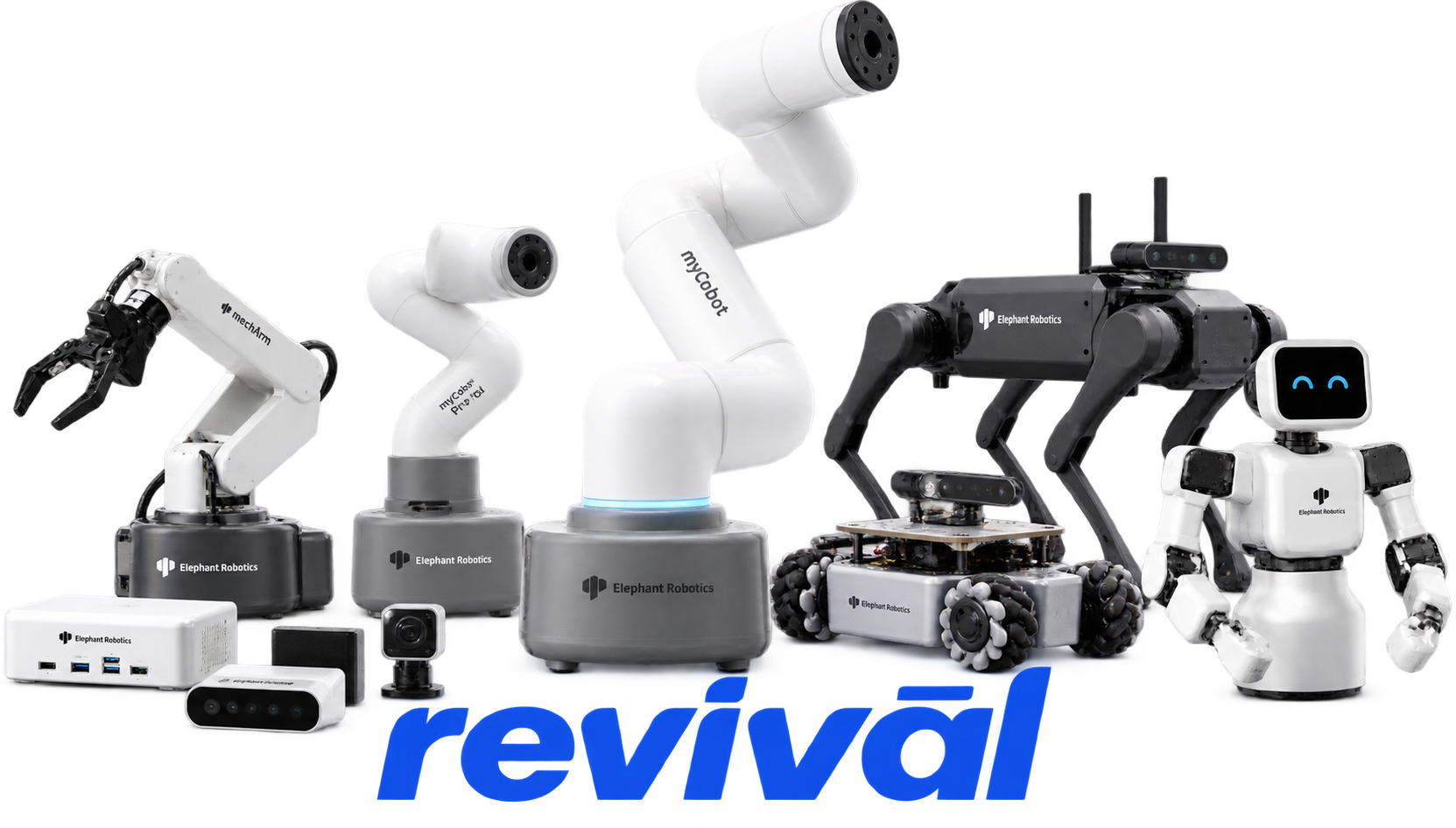
Elephant Robotics is a Shenzhen-based robotics OEM founded in 2016 that develops and manufactures compact collaborative robots, educational robotic arms, mobile robot platforms, humanoid/embodied-AI systems, professional automation robots, and robotic companion pets. Its product families include myCobot, mechArm, ultraArm, myBuddy, myArm, myAGV, myCobot Pro, Mercury humanoid robots, MarsCat, metaCat, and metaDog, alongside robotics education and automation kits. The company targets education, scientific research, AI development, light industrial automation, logistics, commercial applications, and consumer robotics. Elephant Robotics is particularly known for making relatively small, accessible collaborative robotic arms and development platforms that support multiple programming environments and are used by universities, researchers, developers, and automation users worldwide. The company states that its annual shipments exceed 50,000 units and that its products have expanded to dozens of countries and regions.

2 Most Seen Failures:

Joint Servo / Actuator Failure

One or more joints stop moving, fail to enable, or lose torque even though the rest of the robot remains operational. Elephant Robotics specifically directs users to check individual servo status, voltage conditions, resistance, and servo enable state when a joint becomes immobile.


Servo Communication Failure

A joint motor may stop responding because communication between the controller and servo electronics is lost or intermittent. Elephant Robotics documents motor transmission, reception, CAN-bus, and motor-communication circuit errors that can produce missing position feedback or prevent the arm from being controlled.

Encoder / Position Feedback Failure

Failed or abnormal motor-encoder feedback causes incorrect joint-position readings, loss of position information, or complete inability to move the affected axis. Elephant Robotics' industrial and Pro-series error tables specifically identify motor encoder and feedback errors as conditions requiring recovery or hardware inspection.

Power Supply / Undervoltage Failure

Robots may fail to power, unexpectedly disable joints, or behave erratically when the external adapter, wiring, or DC supply develops a fault or voltage drops below specification. Elephant Robotics also documents adapters entering self-protection following a short circuit and servo undervoltage faults during joint troubleshooting.

Motor Overcurrent / Overtemperature Protection

Loaded, stalled, or mechanically restricted joints can trigger overcurrent, I2t, motor-temperature, or driver-board-temperature protection. These conditions disable or interrupt actuator operation until the fault is cleared and the electrical or mechanical cause is corrected.

Joint Shaking / Servo Instability

myCobot and related arms can develop noticeable shaking, oscillation, or unstable holding at individual joints. Elephant Robotics treats arm shaking as a recurring troubleshooting condition involving servo PID parameters, actuator control, and controller firmware.

ATOM / Controller Board Failure

Failure or instability of the ATOM end-controller can leave the arm unable to communicate with or command its servos despite normal external power. Reported cases include robots becoming nonfunctional after power cycling and requiring ATOM firmware restoration, as well as servo faults that pull the ATOM controller into an abnormal state.

Adaptive Gripper Jamming / Zero Drift

Adaptive grippers can become stuck closed, stop responding correctly, or develop an incorrect end/zero position after repeated operation. Elephant Robotics documents gripper zero-position abnormalities after extended gripping use, and users have reported adaptive grippers closing and remaining mechanically stuck.

Mechanical Joint Binding / Excessive Resistance

Joint hardware can become unusually stiff, rough, or difficult to move because mechanical fasteners or joint structures are too tight or because an actuator has developed abnormal internal resistance. Elephant Robotics specifically instructs users to compare joint resistance and, on some models, loosen structural fasteners when movement becomes rough or restricted.

1 Acme Revival offers repair, service, and part rebuild opportunities for most Elephant Robotics devices.

Connect with a technician.

  1. 1 Repairs are performed on a best-effort basis. Acme Revival utilizes a network of sophisticated technicians and engineers with diverse service offerings; despite this, factors that influence the repair outcome may ultimately prove unsuccessful. Acme Revival makes no claim that it can, guarantee a repair before your device is sent in for diagnostic evaluation; even then, repair and diagnostic work are not mutually exclusive. Despite well-intentioned quoting, repairs may still prove unsuccessful.
  2. 2 Per information known, researched and collected by Acme Revival and its systems at time of page publishing (September 29, 2026).
  3. *Information regarding this manufacturer/brand/organization is estimated with information collected and known to Acme Revival. This information is intended to provide insights into the spotlight entity, however may not be accurate— information is strictly of estimate nature only.
  4. **The model list shown here may not be an all-inclusive list of the EcoFlow product range. Model list has been derived per information known, researched and collected by Acme Revival and its systems for the US market.