No POST / No Display
ECS motherboards commonly present with fans and power LEDs operating but no POST or video output. Faults can originate from failed motherboard circuitry, memory initialization, BIOS/CMOS problems, or graphics initialization.

Acme Revival is an independent repair network that operates separately from the manufacturers whose devices we service. Our independence enables a repair model that exists beyond manufacturer-controlled strategies, while preserving the ability to work with manufacturers where appropriate.
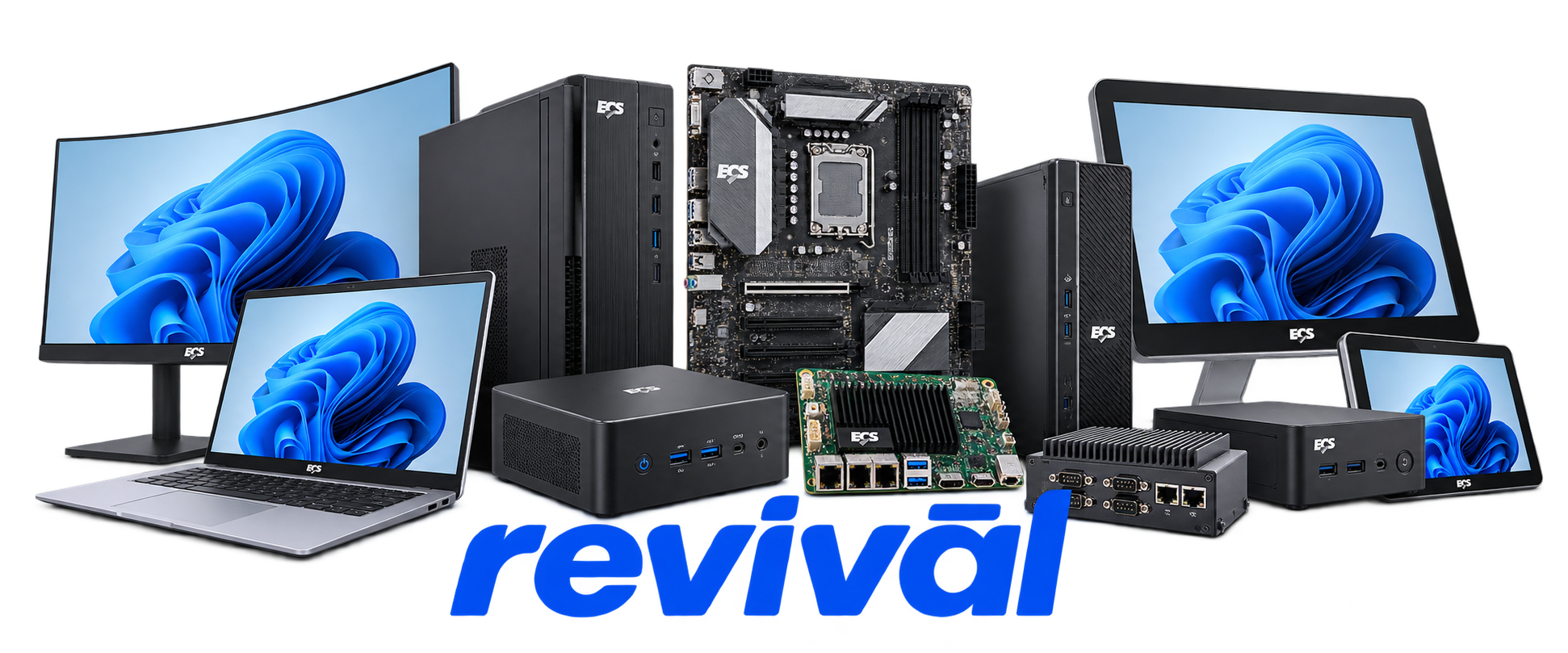
Elitegroup Computer Systems Co., Ltd., commonly known as ECS, is a Taiwanese computer-hardware designer and manufacturer founded in 1987. It became particularly well known as a major motherboard manufacturer and OEM/ODM supplier, producing boards and complete computing systems for both its own brands and large computer companies. Its product portfolio has expanded to include desktop PCs, notebooks, tablets, all-in-one computers, graphics products, industrial computing systems, LIVA mini PCs, embedded/edge-computing platforms, and EV-related products. In addition to branded hardware, ECS provides OEM/ODM manufacturing, hardware/software design, system integration, product testing, and customized computing solutions. Today its business is increasingly oriented toward mini PCs, commercial and embedded systems, AI/edge computing, and OEM/ODM production rather than primarily the enthusiast retail-motherboard market.
ECS motherboards commonly present with fans and power LEDs operating but no POST or video output. Faults can originate from failed motherboard circuitry, memory initialization, BIOS/CMOS problems, or graphics initialization.
Boards may become completely dead, intermittently power up, or shut off immediately despite a known-good power supply. Typical board-level causes include failed voltage-regulation components, shorted power rails, degraded capacitors, or chipset faults.
ECS motherboards and LIVA systems can shut down, reboot, or become unstable when CPU or chipset temperatures become excessive. Dust-blocked cooling, failed fans, degraded thermal interfaces, and the limited cooling capacity of some compact fanless LIVA systems are common contributors.
Systems may fail to boot, produce BIOS checksum errors, lose settings, or require repeated CMOS clearing. Failed BIOS updates, corrupted firmware, weak CMOS batteries, and CMOS configuration faults are recurring causes.
ECS systems can fail to POST, beep for missing memory, crash, or recognize only part of the installed RAM. Faulty DIMM slots, marginal slot contacts, memory-controller issues, and compatibility problems are frequently reported.
Older ECS motherboards are particularly susceptible to degraded electrolytic capacitors around CPU and power-regulation circuitry. Symptoms include random reboots, instability, difficult startup, shutdowns, and complete motherboard failure.
ECS desktops and LIVA systems may stop recognizing SATA, M.2, eMMC, or other boot storage and consequently fail to load the operating system. Causes range from failing storage devices and connectors to controller, firmware, or motherboard interface faults.
LIVA systems and ECS motherboards can lose wired Ethernet or wireless connectivity, show an undetected network adapter, or develop intermittent connections. Hardware faults may involve the onboard LAN controller, WLAN module, antenna connections, RJ45 circuitry, or motherboard interface.
USB, onboard audio, display outputs, and other integrated ports can stop functioning individually or intermittently. These failures are commonly associated with damaged connectors, onboard controller circuitry, chipset faults, or electrical damage to the associated I/O circuit.
Connect with a technician.

Orders can typically be cancelled 24 hours prior to shipping
Get a real-time offer. Enter the make and model to begin.
Acme offers several ways to pay your service or repair balance.
Securely powered by 
This service is provided by Community Federal Savings Bank (“CFSB”), member FDIC, for which GoCardless Ltd acts as a third-party servicer.
Payable to ACME REVIVAL INC, write ECS in memo line, and mail your check to: 191 University Blvd. Suite 340, Denver, CO 80206. Payment are collected every weekday excluding federal holidays.