E61 Group Head Seal and Gasket Failure
Group-head gaskets, valve seals, and other E61 sealing components harden and wear from repeated heat cycles, causing leaks, dripping, poor sealing around the portafilter, or abnormal group operation.

Acme Revival is an independent repair network that operates separately from the manufacturers whose devices we service. Our independence enables a repair model that exists beyond manufacturer-controlled strategies, while preserving the ability to work with manufacturers where appropriate.
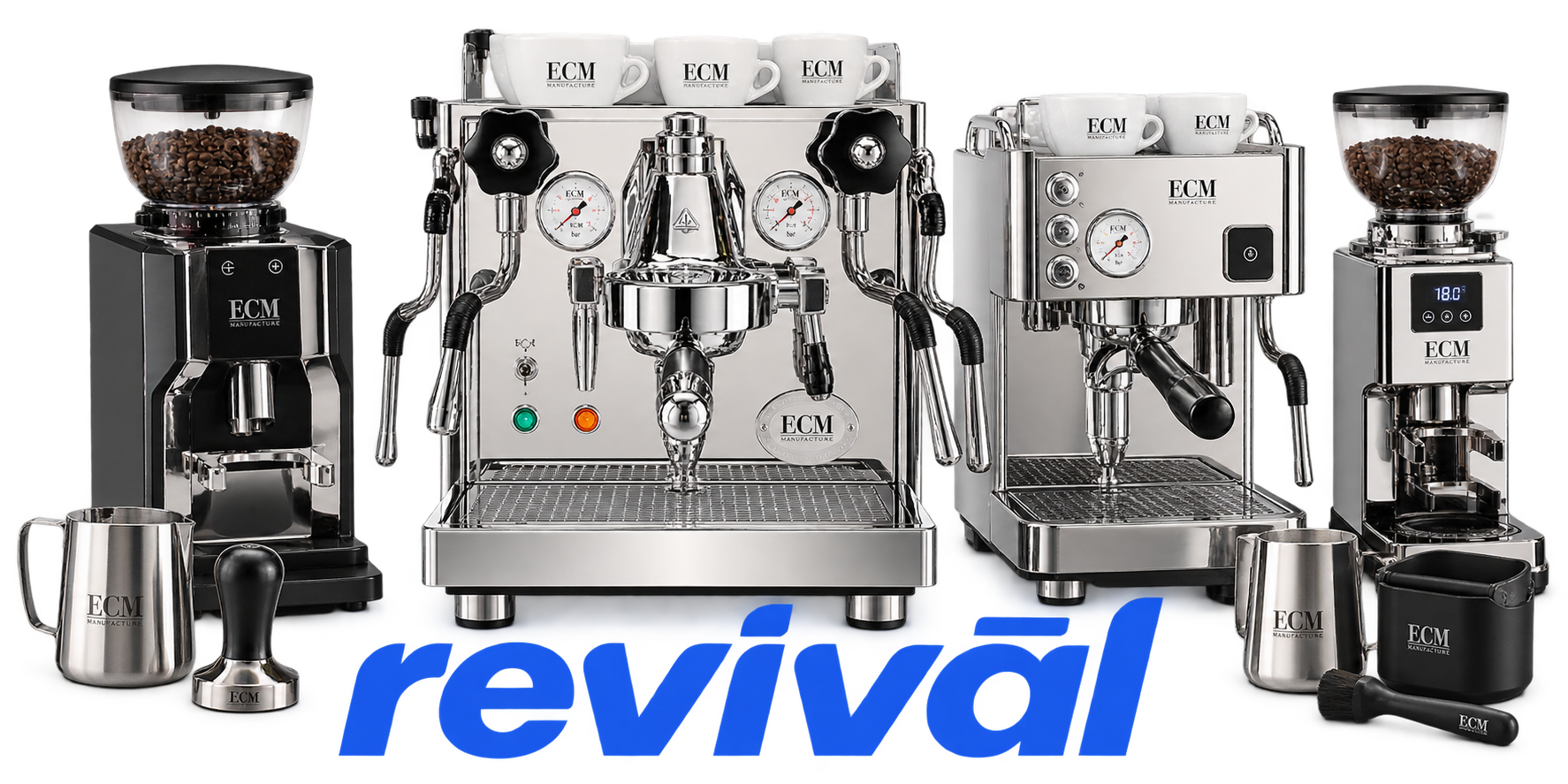
ECM Espresso Coffee Machines Manufacture GmbH is a German, family-owned premium espresso-equipment manufacturer founded in 1996 by Wolfgang Hauck and now led by second-generation managing director Michael Hauck. The company designs, develops, and manufactures high-end semi-automatic espresso machines and coffee grinders for both home-barista and commercial applications, combining German engineering with Italian espresso-machine manufacturing traditions. Its portfolio includes single-boiler, heat-exchanger and dual-boiler machines, commercial multi-group machines, and precision grinders, with well-known product families including Synchronika, Technika, Mechanika, Classika, Puristika, Estetika, Casa, and the S-series grinders. ECM is particularly known for hand-built stainless-steel construction, traditional E61-style brewing technology, premium fit and finish, and café-grade components packaged for enthusiast home use. The company reports a distribution network of more than 500 authorized dealers across over 55 countries and maintains in-house production in Germany and Italy.
Group-head gaskets, valve seals, and other E61 sealing components harden and wear from repeated heat cycles, causing leaks, dripping, poor sealing around the portafilter, or abnormal group operation.
Boiler fittings, tubing, T-connectors, O-rings, and compression connections can deteriorate or loosen, allowing water or steam to leak inside the machine. Synchronika models in particular have recurring reports of brittle or failed internal tubing and connectors.
Rotary and vibratory pumps can wear, develop bypass-valve problems, or fail to prime correctly, resulting in weak pressure, excessive noise, intermittent water delivery, or no flow through the group.
Steam-side faults can cause pressure to fall rapidly or fail to recover, producing weak or short-lived steaming performance. Common causes include boiler-control faults, leaking valves, scale restriction, heating problems, or pressure escaping elsewhere in the steam circuit.
Vacuum breakers and expansion valves commonly develop worn seals or scale contamination, producing persistent dripping, hissing, steam leakage, or water discharge into the drip tray after the machine reaches operating temperature.
Brew- or steam-boiler heating elements can become electrically open, shorted, scaled, or otherwise degraded, leaving the affected boiler unable to reach temperature or causing unusually slow heating.
PID controllers, temperature probes, wiring, and associated control components can drift or fail, causing unstable temperatures, incorrect readings, overheating, failure to heat, or a blank PID display.
Solenoid valves and mechanical E61 valves can stick, clog with scale, or develop worn seals. Symptoms include poor group flow, continuous dripping, failure to release brew pressure, or water being routed incorrectly.
Steam and hot-water valve seals wear with repeated use and heat exposure, causing dripping from the wand, leakage around the valve assembly, stiff joystick operation, or valves that no longer shut off completely.
Connect with a technician.

Orders can typically be cancelled 24 hours prior to shipping
Get a real-time offer. Enter the make and model to begin.
Acme offers several ways to pay your service or repair balance.
Securely powered by 
This service is provided by Community Federal Savings Bank (“CFSB”), member FDIC, for which GoCardless Ltd acts as a third-party servicer.
Payable to ACME REVIVAL INC, write ECM Espresso in memo line, and mail your check to: 191 University Blvd. Suite 340, Denver, CO 80206. Payment are collected every weekday excluding federal holidays.