
DiCon Fiberoptics

Repair, Service, and Parts

DiCon Fiberoptics repair, service, and parts

Acme Revival is an independent repair network that operates separately from the manufacturers whose devices we service. Our independence enables a repair model that exists beyond manufacturer-controlled strategies, while preserving the ability to work with manufacturers where appropriate.

Richmond, California
Manuf. Location
≈ US $29M
Annual Revenue (est)
Optical Networking
End Use Segment

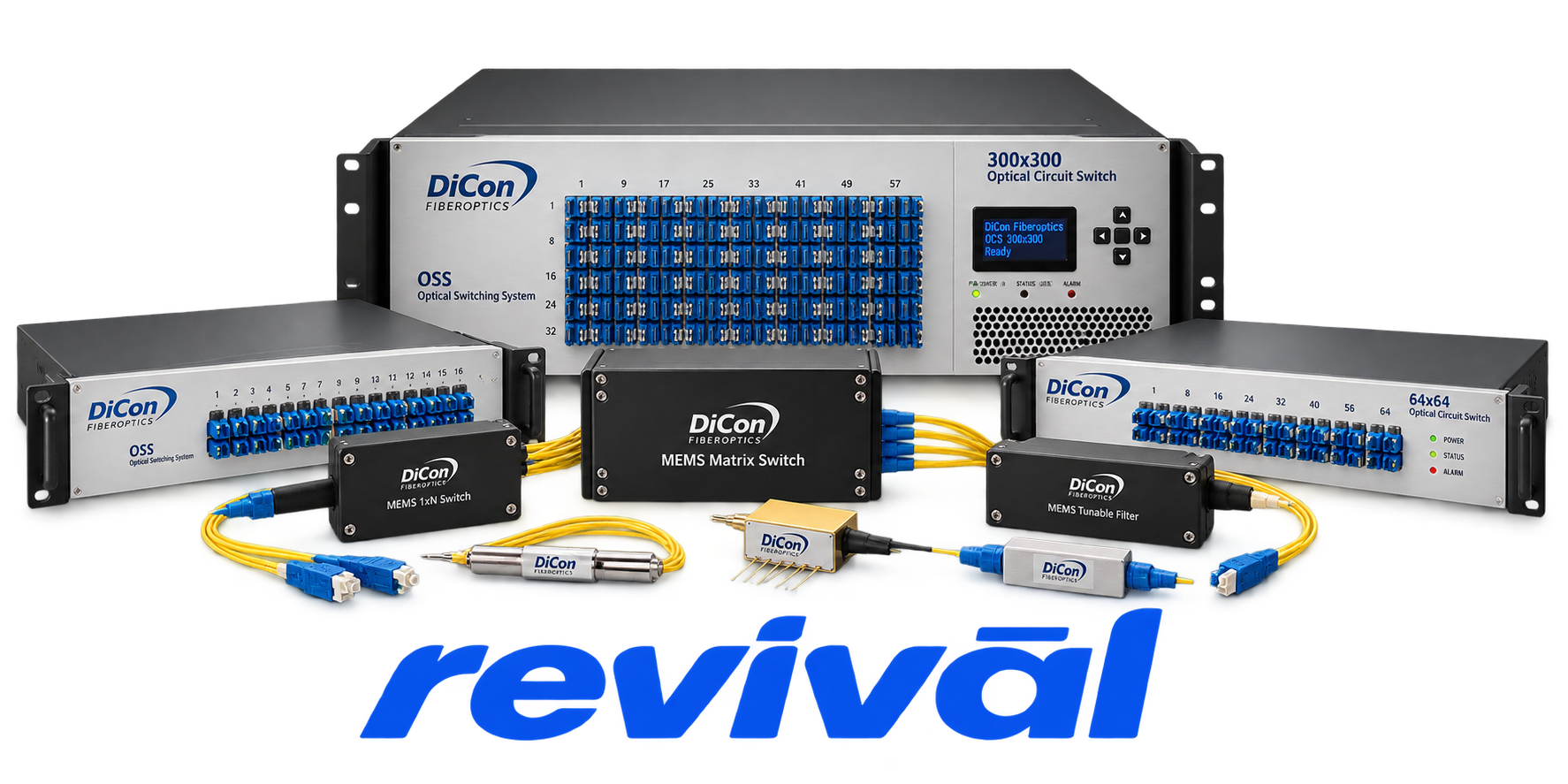
DiCon Fiberoptics is a vertically integrated photonics OEM specializing in MEMS-based optical switching and fiber-optic components and systems. Founded in 1986, the company designs and manufactures optical matrix switches, optical circuit switches, 1xN switches, variable optical attenuators, tunable and thin-film filters, tap detectors, and customized photonic assemblies. DiCon is particularly known for its proprietary MEMS tilting-mirror technology and high-port-count all-optical switching platforms, which are used in optical networks, AI/data-center infrastructure, photonic test automation, quantum systems, aerospace/space communications, and government/defense applications. The company controls much of its manufacturing process internally, from MEMS/chip fabrication through component assembly, electronics, firmware, software, and final systems integration.

2 Most Seen Failures:

Excessive Optical Insertion Loss

Optical power through the selected path is lower than expected or exceeds the model's insertion-loss specification. Common hardware-side contributors include contaminated connectors, damaged fiber, excessive bending, or degradation/misalignment of the optical path.


Fiber Pigtail Breakage or Microbending

Fiber pigtails become damaged from sharp bends, pulling, tight cable ties, or stress near the connector strain-relief boot or switch housing. Damage can produce severe attenuation, intermittent optical performance, or complete loss of the optical path.

Contaminated or Damaged Optical Connectors

Dust, residue, debris, or physical damage on connector end faces increases optical loss and can degrade repeatability and back-reflection performance. DiCon specifically instructs users to keep unused connectors capped and clean exposed connectors.

Switching or Actuation Failure

The commanded optical switch fails to reach the requested port or optical state. Depending on the hardware family, this can involve the MEMS actuation system, drive electronics, or electromechanical actuator failing to position the optical element correctly.

Loss Repeatability or Connection Instability

Repeated selection of the same optical path produces different loss values, or optical power drifts after the connection is established. This represents degradation beyond the tight repeatability and connection-stability limits specified for DiCon MEMS switches.

Excessive Crosstalk or Poor Isolation

Optical energy leaks into an unselected output or an OFF path provides insufficient attenuation. The fault becomes significant when isolation or crosstalk no longer meets the model's specified limit.

Back-Reflection or Return-Loss Degradation

An abnormal amount of optical power is reflected back toward the source. Connector contamination or damage and degradation of the optical path can cause return-loss performance to fall outside specification.

Power Supply or Electronic Hardware Failure

A chassis, controller, or switching assembly experiences a power or electronic hardware fault that prevents normal operation or communication with internal components. DiCon system designs use features such as redundant power supplies and hardware fault monitoring to mitigate or detect these failures.

Internal Controller or Hardware Communication Failure

The system loses communication between internal hardware components or a controller/interface becomes unresponsive. Documented DiCon system fault detection includes hardware-component communication failures, checksum mismatches, and motherboard or user-interface crashes.

1 Acme Revival offers repair, service, and part rebuild opportunities for most DiCon Fiberoptics devices.

Connect with a technician.

  1. 1 Repairs are performed on a best-effort basis. Acme Revival utilizes a network of sophisticated technicians and engineers with diverse service offerings; despite this, factors that influence the repair outcome may ultimately prove unsuccessful. Acme Revival makes no claim that it can, guarantee a repair before your device is sent in for diagnostic evaluation; even then, repair and diagnostic work are not mutually exclusive. Despite well-intentioned quoting, repairs may still prove unsuccessful.
  2. 2 Per information known, researched and collected by Acme Revival and its systems at time of page publishing (September 25, 2026).
  3. *Information regarding this manufacturer/brand/organization is estimated with information collected and known to Acme Revival. This information is intended to provide insights into the spotlight entity, however may not be accurate— information is strictly of estimate nature only.
  4. **The model list shown here may not be an all-inclusive list of the EcoFlow product range. Model list has been derived per information known, researched and collected by Acme Revival and its systems for the US market.