Power Supply Failure
One of the redundant power inputs or external power supplies fails, typically indicated by a missing or red POWER LED. Redundancy is reduced and monitoring can be interrupted if the remaining supply also fails.

Acme Revival is an independent repair network that operates separately from the manufacturers whose devices we service. Our independence enables a repair model that exists beyond manufacturer-controlled strategies, while preserving the ability to work with manufacturers where appropriate.
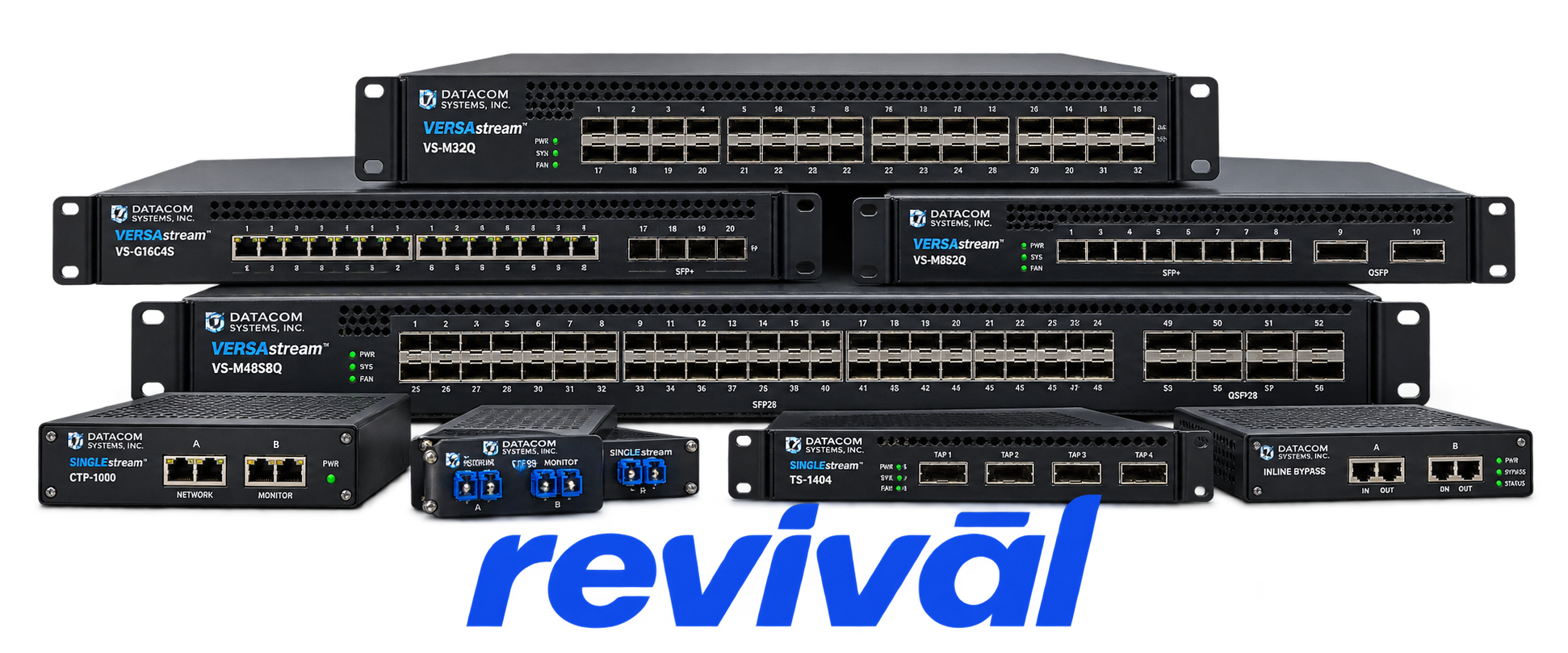
Datacom Systems, Inc. is a U.S. manufacturer specializing in network visibility and network-access hardware. Founded in 1992, the company develops and assembles equipment that gives enterprise security, monitoring, and performance-management tools access to network traffic. Its core hardware portfolio consists of copper and fiber Network TAPs, aggregation TAPs, Network Packet Brokers (NPBs), and in-line bypass switches, including high-density systems supporting network speeds up to 400G. These devices copy, aggregate, filter, distribute, and route network traffic to monitoring and cybersecurity tools without disrupting production networks. Datacom says it pioneered the network-visibility market with the development of the first matrix switch in 1992 and today serves enterprise, government, communications, healthcare, financial, and industrial environments. The company is particularly known for its SINGLEstream aggregation TAPs, VERSAstream packet brokers, network TAP products, and U.S.-assembled network visibility equipment.
One of the redundant power inputs or external power supplies fails, typically indicated by a missing or red POWER LED. Redundancy is reduced and monitoring can be interrupted if the remaining supply also fails.
A network port fails to establish or maintain link with its connected endpoint, resulting in loss or interruption of traffic through that path. Causes include cabling, endpoint negotiation, port configuration, or loss of the opposite link.
A monitor port establishes no link or stops delivering copied traffic to the connected analysis tool. This can result from incorrect cabling, incompatible port settings, loss of input traffic, or incorrect fiber orientation.
SINGLEstream aggregation models can drop monitored packets when the combined bidirectional traffic exceeds the capacity of the aggregation output. Datacom specifically identifies aggregate link utilization above 50% as creating a risk of packet loss on a 1-Gbps full-duplex link.
Incorrect TX/RX fiber orientation causes little or no usable optical signal to reach a TAP monitor port even though the production link may continue functioning. Datacom identifies reversed fiber direction as a common cause of link faults at connected monitoring tools.
A passive fiber TAP's optical split reduces the light available to both the production link and monitoring equipment. If the installation's optical power budget cannot tolerate this insertion/split loss, receivers may experience link faults or fail to establish a reliable connection.
Copper TAP links may fail to communicate correctly when endpoints with different maximum speeds are left in incompatible auto-negotiation configurations. Datacom recommends hard-setting both ends to the maximum mutually supported speed in this situation.
Active copper TAPs and bypass hardware can briefly interrupt the production link when power is lost, restored, or the hardware transitions into passive bypass. This interruption can trigger link renegotiation and routing or protocol recalculation, producing temporary downtime.
SS-1200, SS-2200, and SS-4200-series SINGLEstream hardware does not support PoE on tapped links and does not pass jumbo frames on tapped copper links. Deploying these models where those features are required can therefore appear as loss of PoE functionality or failure of oversized traffic.
Connect with a technician.

Orders can typically be cancelled 24 hours prior to shipping
Get a real-time offer. Enter the make and model to begin.
Acme offers several ways to pay your service or repair balance.
Securely powered by 
This service is provided by Community Federal Savings Bank (“CFSB”), member FDIC, for which GoCardless Ltd acts as a third-party servicer.
Payable to ACME REVIVAL INC, write Datacom Systems in memo line, and mail your check to: 191 University Blvd. Suite 340, Denver, CO 80206. Payment are collected every weekday excluding federal holidays.