Drive Not Detected
The installed HDD or SSD fails to appear on the host computer because of failed interface electronics, poor carrier seating, damaged connectors, or loss of the SATA/SAS data path.

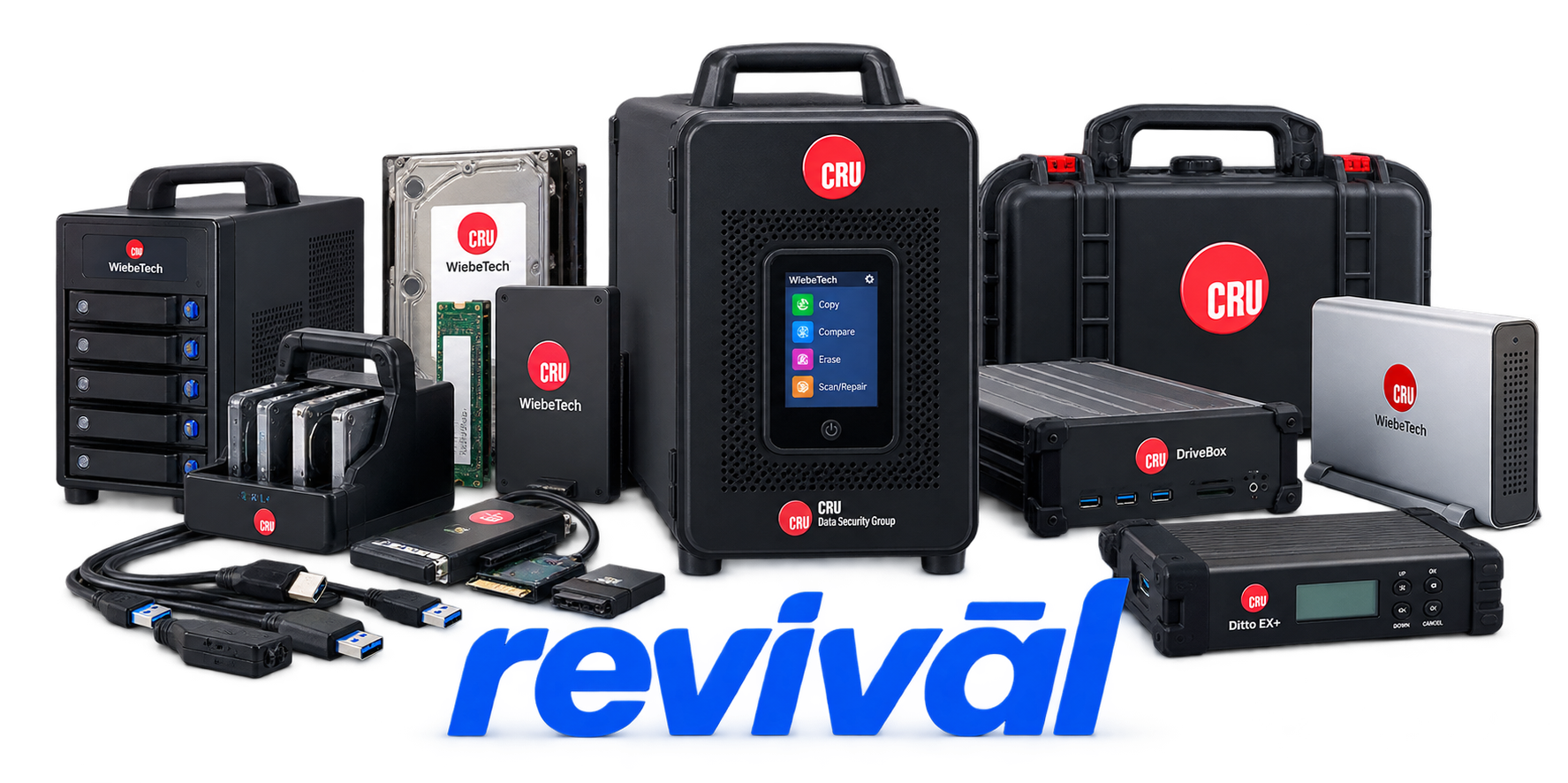
Acme Revival is an independent repair network that operates separately from the manufacturers whose devices we service. Our independence enables a repair model that exists beyond manufacturer-controlled strategies, while preserving the ability to work with manufacturers where appropriate.
CRU Data Security Group is a U.S.-based storage-hardware OEM founded in 1986 that specializes in secure removable data-storage and physical data-transport systems. Its CRU product line includes removable drive bays and carriers, rugged external storage systems, encrypted portable drives, secure drive enclosures, write-protection hardware, and related storage solutions designed to let organizations physically remove, transport, protect, and control access to sensitive data. CRU products are particularly associated with government, military, defense, intelligence, law-enforcement, digital-cinema, and commercial computing environments, where removable storage and long product lifecycles are important. The company says millions of its removable-drive products have been deployed worldwide, and its current portfolio emphasizes physical data security, tamper resistance, ruggedization, and integration into long-lived computing platforms.
The installed HDD or SSD fails to appear on the host computer because of failed interface electronics, poor carrier seating, damaged connectors, or loss of the SATA/SAS data path.
Internal or bay cooling fans stop operating or fall below their expected speed, commonly triggering a flashing status LED or audible fan-failure alarm. Continued operation can lead to excessive drive temperatures.
The enclosure or removable-drive bay fails to power up because of a failed AC adapter, internal power connection, power circuitry, or key-operated power switch. Symptoms typically include no LEDs and no drive spin-up.
Multi-drive DataPAK, RTX, and ToughTech systems can enter a degraded or failed RAID state when a disk becomes unreadable, develops damaged sectors, or drops from the array. The system may generate an audible alarm and require drive replacement and array rebuilding.
Repeated insertion and removal of DataPort carriers can damage or bend electrical contacts, preventing reliable power or data communication between the carrier and receiving frame. The drive may become intermittent or disappear completely.
Secure DataPort, RTX Secure, and ToughTech Secure models may fail to recognize the hardware security key, preventing the encryption processor from accessing the installed drive. CRU documentation identifies missing, damaged, or unreadable keys and key-interface faults as causes.
Hard drives and enclosure electronics can reach warning or alarm temperatures because of failed cooling, restricted airflow, or prolonged heavy operation. ToughTech and other monitored CRU products can illuminate warning LEDs or sound temperature alarms when thresholds are exceeded.
A failed or intermittent interface connection can cause disconnects, missing drives, unstable transfers, or complete loss of host communication. Faults may originate in the enclosure interface board, external connector, cable connection, or carrier-to-frame data path.
The HDD or SSD installed inside the CRU enclosure can develop unreadable sectors, mechanical faults, or electronic failures that cause a "Failing" status, RAID degradation, or complete loss of drive detection. CRU RAID products specifically monitor for these disk failures and initiate degraded-state warnings.
Connect with a technician.

Orders can typically be cancelled 24 hours prior to shipping
Get a real-time offer. Enter the make and model to begin.
Acme offers several ways to pay your service or repair balance.
Securely powered by 
This service is provided by Community Federal Savings Bank (“CFSB”), member FDIC, for which GoCardless Ltd acts as a third-party servicer.
Payable to ACME REVIVAL INC, write CRU in memo line, and mail your check to: 191 University Blvd. Suite 340, Denver, CO 80206. Payment are collected every weekday excluding federal holidays.