
Cohesity

Repair, Service, and Parts

Cohesity repair, service, and parts

Acme Revival is an independent repair network that operates separately from the manufacturers whose devices we service. Our independence enables a repair model that exists beyond manufacturer-controlled strategies, while preserving the ability to work with manufacturers where appropriate.

Riyadh, Riyadh Province, Saudi Arabia
Manuf. Location
≈ US $1.7B
Annual Revenue (est)
Data Protection
End Use Segment

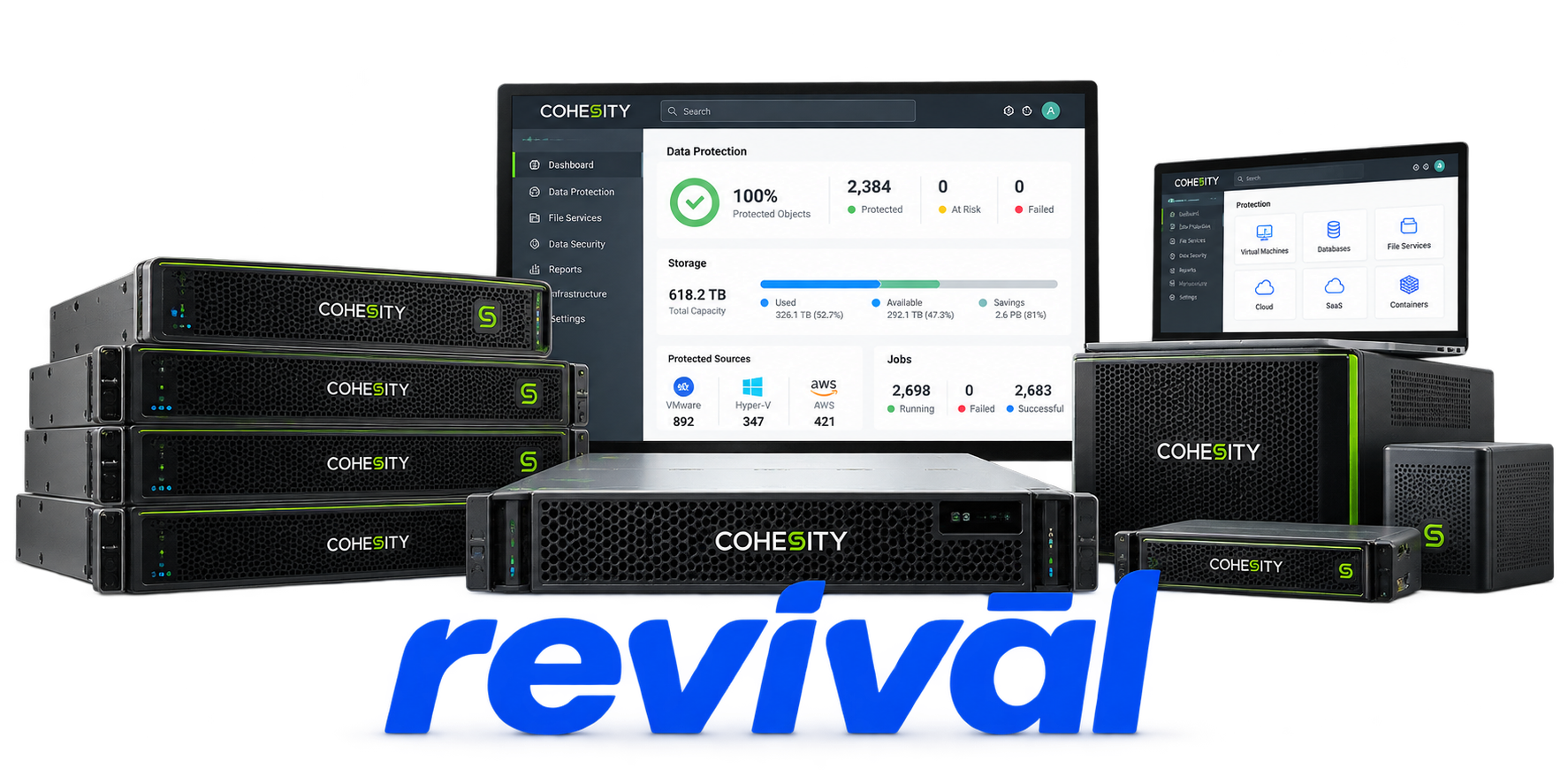
Cohesity is an enterprise data security, backup, recovery, and data-management OEM/software provider focused on protecting large organizations' data across data centers, edge infrastructure, SaaS applications, and public clouds. Its portfolio centers on the Cohesity Data Cloud and includes DataProtect for backup and recovery, SmartFiles for file/object storage, FortKnox for isolated cyber-vaulting, Security Center and threat-protection products, Helios centralized management, and the NetBackup product family acquired through the combination with Veritas' enterprise data-protection business. Cohesity also offers integrated physical appliances, including its C-series systems and the NetBackup/Flex appliance families, while supporting deployments on certified third-party hardware from major server manufacturers. Its core market position is enterprise cyber resilience: immutable backups, ransomware detection and recovery, disaster recovery, secure data isolation, and rapid restoration of business workloads after outages or cyberattacks.

2 Most Seen Failures:

HDD Failure

One or more mechanical hard drives develop media errors, bad sectors, SMART faults, or stop responding, placing the affected storage node into a degraded state. Cohesity specifically designs its clusters to tolerate multiple HDD failures while rebuilding affected data from erasure-coded or replicated copies.


SSD Failure

An SSD used for distributed metadata, journaling, caching, or other node storage becomes faulted or inaccessible. Because Cohesity distributes metadata and journal data across nodes, an SSD failure can effectively behave like a node failure and initiate recovery or rebalancing.

Power Supply Failure

One of the redundant power-supply modules stops supplying proper output, reports zero/abnormal wattage, or develops an internal electrical fault. Cohesity appliances generally use redundant PSUs so a single failed module can be replaced without immediately taking the entire appliance offline.

Cooling Fan Failure

A chassis or storage-shelf fan stops, runs below its expected speed, or produces an abnormal RPM reading. Loss of sufficient airflow can raise internal temperatures and eventually cause thermal warnings, component throttling, or shutdown if the failed fan is not replaced.

DIMM / Memory Failure

A server DIMM develops correctable or uncorrectable ECC memory errors, potentially resulting in a failed memory-module state or node instability. Persistent uncorrectable errors generally require replacement of the affected DIMM.

Network Interface Failure

A NIC, network port, transceiver, cable interface, or associated network hardware loses connectivity or becomes unreliable. Cohesity's redundant network architecture can fail over traffic and reassign services when a directly connected network link goes down.

Node / Motherboard Failure

A complete node becomes unavailable because of motherboard, processor, power-distribution, PCIe, memory, or other system-level hardware faults. Cohesity's distributed architecture replicates metadata and protects file data so cluster services can continue through supported node-failure scenarios.

RAID / Storage Controller Failure

A RAID, HBA, storage controller, backplane connection, or associated storage path becomes faulted or changes from its normal optimal state. This can make multiple drives inaccessible simultaneously and generate degraded-storage or hardware-health alerts even when the individual disks remain functional.

Overtemperature / Thermal Failure

Restricted airflow, failed cooling hardware, excessive ambient temperature, or internal component heating causes chassis, intake, exhaust, or storage-shelf temperature sensors to exceed operating limits. Persistent thermal faults can produce critical hardware alerts and may lead to protective shutdowns or accelerated drive and electronic-component failure.

1 Acme Revival offers repair, service, and part rebuild opportunities for most Cohesity devices.

Connect with a technician.

  1. 1 Repairs are performed on a best-effort basis. Acme Revival utilizes a network of sophisticated technicians and engineers with diverse service offerings; despite this, factors that influence the repair outcome may ultimately prove unsuccessful. Acme Revival makes no claim that it can, guarantee a repair before your device is sent in for diagnostic evaluation; even then, repair and diagnostic work are not mutually exclusive. Despite well-intentioned quoting, repairs may still prove unsuccessful.
  2. 2 Per information known, researched and collected by Acme Revival and its systems at time of page publishing (September 24, 2026).
  3. *Information regarding this manufacturer/brand/organization is estimated with information collected and known to Acme Revival. This information is intended to provide insights into the spotlight entity, however may not be accurate— information is strictly of estimate nature only.
  4. **The model list shown here may not be an all-inclusive list of the EcoFlow product range. Model list has been derived per information known, researched and collected by Acme Revival and its systems for the US market.