
Celestron Acquisition

Repair, Service, and Parts

Celestron Acquisition repair, service, and parts

Acme Revival is an independent repair network that operates separately from the manufacturers whose devices we service. Our independence enables a repair model that exists beyond manufacturer-controlled strategies, while preserving the ability to work with manufacturers where appropriate.

Suzhou / Rugao, Jiangsu, China; Torrance, Los Angeles County, California, USA
Manuf. Location
≈ US $10–25M
Annual Revenue (est)
Astronomical Optics
End Use Segment

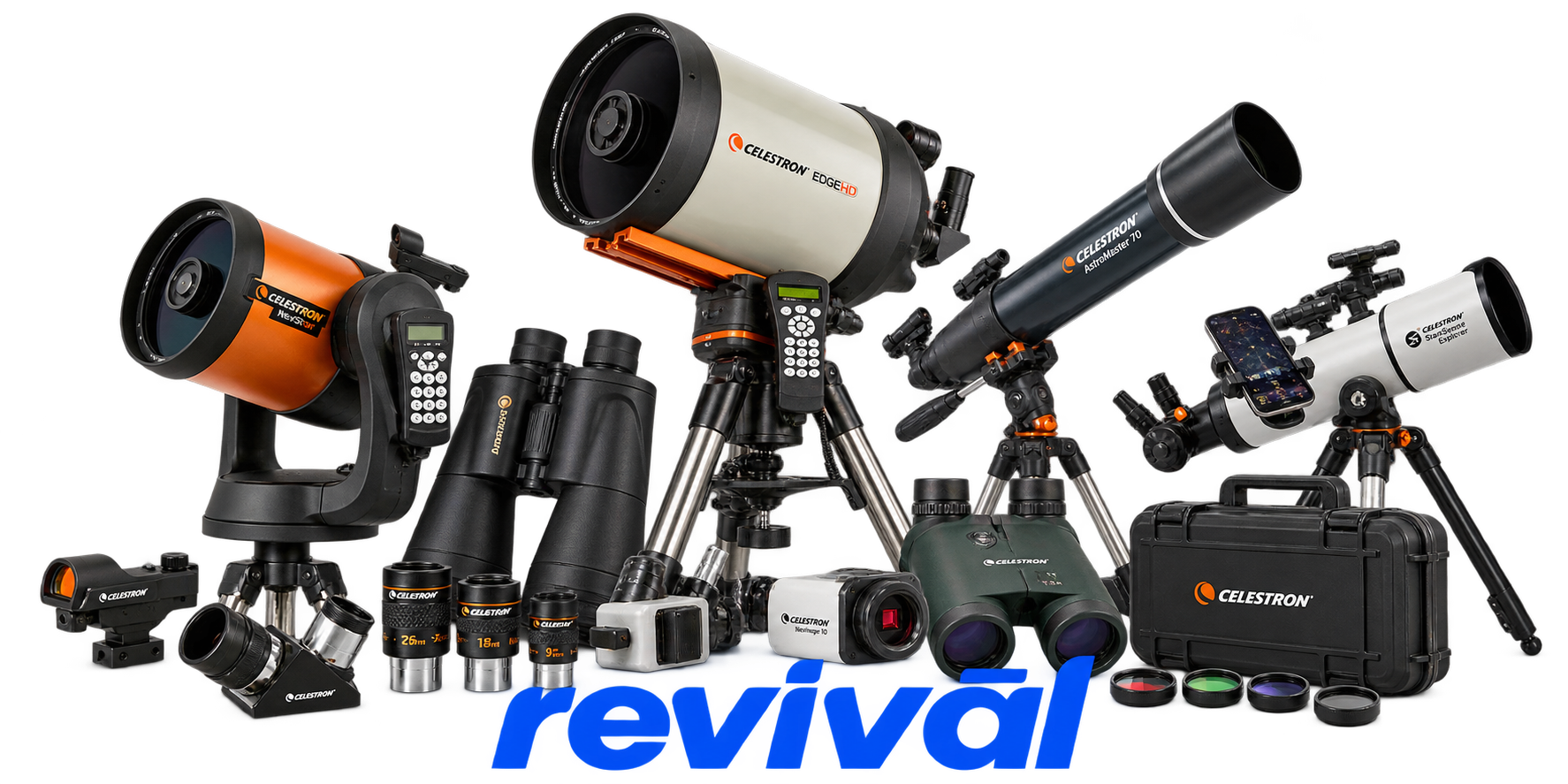
Celestron Acquisition, LLC is a U.S. optical and astronomical-equipment company best known for designing and marketing telescopes for amateur astronomy, education, astrophotography, and advanced observing. Founded from the Celestron telescope business established in 1960, the company became particularly associated with commercially accessible Schmidt-Cassegrain telescopes and today offers computerized and manual telescopes, EdgeHD optical systems, RASA astrographs, StarSense-equipped systems, telescope mounts, astronomical imaging equipment, binoculars, spotting scopes, microscopes, and related optical/electronic accessories. Celestron operates from Torrance, California and is part of the broader Synta corporate/manufacturing group; much of its volume production has been sourced through Synta-affiliated manufacturing operations in Jiangsu, China, while specialized flagship optical systems continue to receive optical processing and assembly in Torrance.

2 Most Seen Failures:

Power Input / DC Jack Failure

Intermittent or failed DC power connections are extremely common across Celestron computerized mounts, causing resets, erratic slewing, communication errors, or complete loss of power. Common hardware causes include worn power jacks, loose center pins, oxidized contacts, damaged wiring, and failing battery connections.


Motor Control Board Failure

RA/azimuth or DEC/altitude motor-control electronics can fail and produce "No Response 16" or "No Response 17" errors, loss of an axis, or uncontrolled slewing. Failures may involve motor-driver ICs, power circuitry, damaged connectors, or the motor-control PCB itself.

Hand Controller Failure

NexStar and StarSense hand controllers can freeze, remain stuck at "Initializing," display no-response errors, reboot unexpectedly, or fail to communicate with the mount. Faults can originate from the controller electronics, keypad, display, cable, connector, or corrupted controller firmware.

RA / Azimuth Drive Failure

The right-ascension or azimuth axis may stop moving, move intermittently, jerk, or fail to track accurately because of motor, encoder, gearbox, wiring, or motor-driver problems. On computerized mounts this frequently presents as a No Response 16 condition or an axis that stops during a slew.

DEC / Altitude Drive Failure

The declination or altitude axis can become nonresponsive, move erratically, or stop during GoTo operations because of motor, encoder, gearbox, cable, or motor-control faults. Celestron associates loss of communication with this axis with the No Response 17 error.

HC / AUX Port and Communication Failure

Damaged, contaminated, loose, or electrically failed HC/AUX ports can prevent the hand controller, StarSense, focus motor, or other accessories from communicating with the mount. Bent contacts, connector corrosion, cracked solder joints, damaged cables, and failed interface circuitry are typical causes.

Gear Backlash / Gearbox Failure

Excessive backlash, worn gears, loose gear engagement, damaged reduction gears, or deteriorating clutch components can produce delayed axis response, poor GoTo accuracy, tracking errors, slipping, or abnormal mechanical noise. These problems become increasingly noticeable as drive assemblies accumulate wear.

Firmware / Bootloader Corruption

Celestron computerized hardware can become stuck at "Initializing," display BOOT LOADER or "Invalid Package" errors, or lose communication after corrupted or interrupted firmware programming. A successful CFM reflash can recover firmware-only cases, while persistent errors can indicate an underlying controller or communication-board fault.

Focus Motor / Electronic Focuser Failure

Celestron Focus Motors can stop responding, fail to be detected, stall, or generate "No Response 18" because of motor, cable, connector, controller, or internal electronics failure. If firmware recovery does not restore communication, Celestron identifies the focus-motor hardware or its cable as likely fault areas.

1 Acme Revival offers repair, service, and part rebuild opportunities for most Celestron Acquisition devices.

Connect with a technician.

  1. 1 Repairs are performed on a best-effort basis. Acme Revival utilizes a network of sophisticated technicians and engineers with diverse service offerings; despite this, factors that influence the repair outcome may ultimately prove unsuccessful. Acme Revival makes no claim that it can, guarantee a repair before your device is sent in for diagnostic evaluation; even then, repair and diagnostic work are not mutually exclusive. Despite well-intentioned quoting, repairs may still prove unsuccessful.
  2. 2 Per information known, researched and collected by Acme Revival and its systems at time of page publishing (September 23, 2026).
  3. *Information regarding this manufacturer/brand/organization is estimated with information collected and known to Acme Revival. This information is intended to provide insights into the spotlight entity, however may not be accurate— information is strictly of estimate nature only.
  4. **The model list shown here may not be an all-inclusive list of the EcoFlow product range. Model list has been derived per information known, researched and collected by Acme Revival and its systems for the US market.