
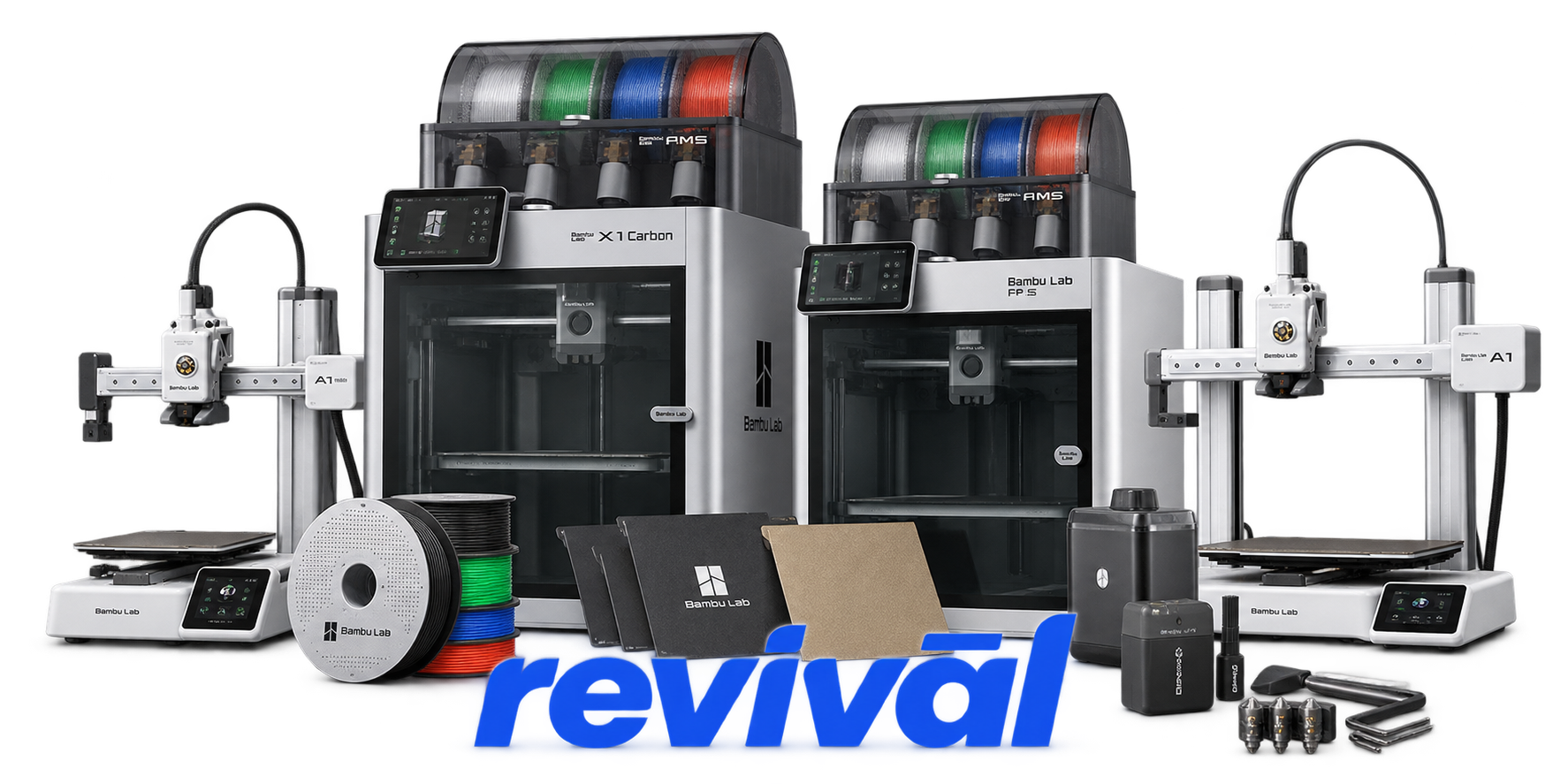
Bambu Lab

Repair, Service, and Parts

Bambu Lab repair, service, and parts

Acme Revival is an independent repair network that operates separately from the manufacturers whose devices we service. Our independence enables a repair model that exists beyond manufacturer-controlled strategies, while preserving the ability to work with manufacturers where appropriate.

Guangming District, Shenzhen, Guangdong, China
Manuf. Location
≈ US $210M
Annual Revenue (est)
Desktop 3D Printing
End Use Segment

Bambu Lab (Shenzhen Tuozhu Technology Co., Ltd.) is a Chinese additive-manufacturing technology company founded in 2020 that specializes in high-speed desktop fused-filament 3D printers and the supporting hardware, materials, and software ecosystem. The company became prominent with its X1 series and subsequently expanded across the A, P, X, and H printer families, emphasizing automated calibration, high-speed motion systems, multi-color/multi-material printing, machine vision and tightly integrated software. Its engineering team has expertise spanning robotics, motion control, artificial intelligence, embedded systems and materials, and the company is particularly known for bringing capabilities formerly associated with higher-end industrial machines—such as fast CoreXY printing, automated material handling and engineering-material support—into relatively accessible desktop systems. Bambu Lab also operates MakerWorld and sells printing filament and related ecosystem products, positioning itself as an integrated hardware/software/materials platform rather than solely a printer manufacturer.

2 Most Seen Failures:

Nozzle / Hotend Clogging

Filament becomes obstructed inside the nozzle, heatbreak, or hotend, causing under-extrusion, clicking, failed extrusion, or complete loss of filament flow. Repeated clogs can also cause AMS loading/retraction errors and extruder gear slipping.


AMS Filament Feed / Retract Failure

The AMS fails to push filament into the toolhead or pull it back after printing or a material change. Common causes include excessive PTFE-path friction, worn feeder components, spool resistance, filament debris, hub/buffer problems, or insufficient feeder traction.

Extruder Gear / Filament Jam

Filament debris, softened filament, broken filament, or worn drive gears can jam the extruder and prevent reliable material movement. Symptoms commonly include clicking or grinding, filament being chewed by the gears, and "failed to extrude" errors.

AMS First-Stage Feeder Wear / Failure

AMS and AMS Lite feeder mechanisms can lose grip, slip, grind filament, or stop transporting filament reliably as gears, springs, rollers, and associated components wear. Failures may initially affect a single AMS slot before becoming persistent.

Hotend Heater / Thermistor Failure

The ceramic heater, thermistor, or associated wiring can develop intermittent or complete failure, producing abnormal nozzle-temperature readings or preventing the hotend from reaching temperature. Thermal cycling and repeated toolhead movement can contribute to wiring and heater degradation.

Cooling Fan Failure

Hotend, control-board, chamber, and auxiliary fans can develop worn bearings, abnormal noise, reduced speed, or complete loss of operation. Fan failure can trigger monitoring errors and may contribute to heat-creep, hotend clogs, or electronics overheating.

Filament Cutter Wear / Jamming

The toolhead filament cutter can become dull, mechanically restricted, or fail to return completely after cutting. Incomplete cuts frequently manifest as filament-change, AMS unloading, or "failed to pull back filament" problems.

Heatbed / Heatbed Cable Failure

Heatbed wiring, temperature sensing, or heater circuitry can cause unstable bed-temperature readings, intermittent heating, or complete loss of heating. The A1 had a documented heatbed-cable defect in which cable damage near the printer base could cause electrical shorts, sparking, or damaged insulation.

PTFE Tube / Filament Path Wear

PTFE tubes and filament guides develop internal wear, grooves, deformation, poor alignment, or excessive bends that increase drag on the filament. The resulting resistance commonly causes AMS motor overload, repeated feed/retract errors, filament grinding, and unreliable material changes.

1 Acme Revival offers repair, service, and part rebuild opportunities for most Bambu Lab devices.

Connect with a technician.

  1. 1 Repairs are performed on a best-effort basis. Acme Revival utilizes a network of sophisticated technicians and engineers with diverse service offerings; despite this, factors that influence the repair outcome may ultimately prove unsuccessful. Acme Revival makes no claim that it can, guarantee a repair before your device is sent in for diagnostic evaluation; even then, repair and diagnostic work are not mutually exclusive. Despite well-intentioned quoting, repairs may still prove unsuccessful.
  2. 2 Per information known, researched and collected by Acme Revival and its systems at time of page publishing (September 21, 2026).
  3. *Information regarding this manufacturer/brand/organization is estimated with information collected and known to Acme Revival. This information is intended to provide insights into the spotlight entity, however may not be accurate— information is strictly of estimate nature only.
  4. **The model list shown here may not be an all-inclusive list of the EcoFlow product range. Model list has been derived per information known, researched and collected by Acme Revival and its systems for the US market.