
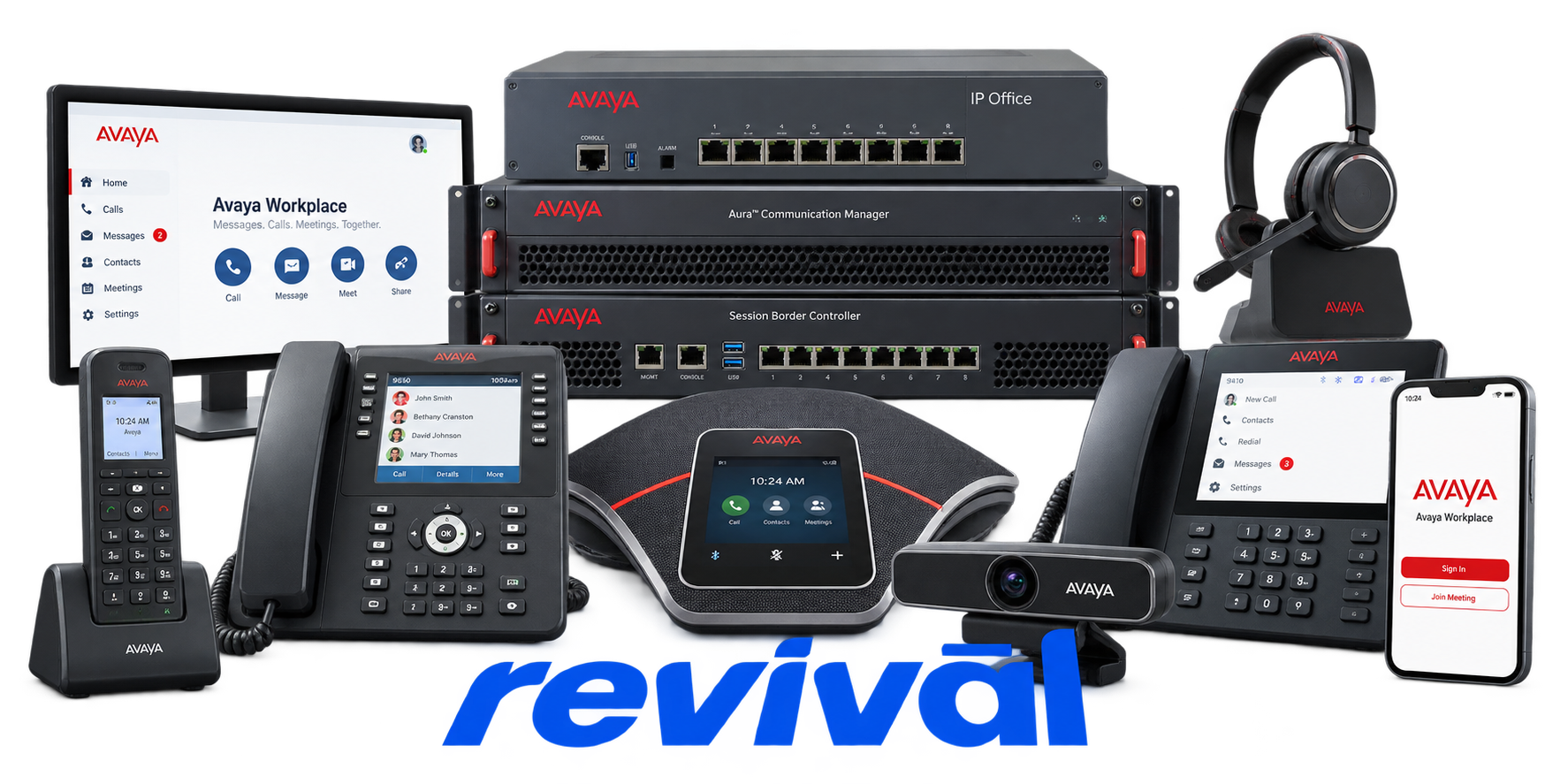
Avaya

Repair, Service, and Parts

Avaya repair, service, and parts

Acme Revival is an independent repair network that operates separately from the manufacturers whose devices we service. Our independence enables a repair model that exists beyond manufacturer-controlled strategies, while preserving the ability to work with manufacturers where appropriate.

Southern China
Manuf. Location
≈ US $1.8B
Annual Revenue (est)
Enterprise Communications
End Use Segment

Avaya is an enterprise communications technology manufacturer and software provider best known for business telephone systems, IP desk phones, contact-center infrastructure, unified communications platforms, media gateways, conferencing equipment, and related enterprise voice hardware. Its product ecosystem includes the Avaya Aura and IP Office platforms along with J100-series IP phones and other communications endpoints. Although Avaya increasingly emphasizes software, cloud, AI-enabled customer experience, and contact-center solutions, it continues to support a large installed base of physical communications hardware used by corporations, government organizations, call centers, and other large enterprises. Avaya designs and specifies its hardware but has historically outsourced most physical manufacturing to contract manufacturers.

2 Most Seen Failures:

No Power / Dead Unit

Avaya IP phones, IP Office control units, and gateways commonly fail to power on because of failed internal power supplies, PoE circuitry, DC input stages, or power-related board faults. Affected phones may have no LEDs or display, while modules can leave all attached extensions dead. :contentReference[oaicite:0]{index=0}


Ethernet / Network Port Failure

Ethernet interface faults can prevent Avaya IP phones and gateways from obtaining network connectivity, registering, or completing startup. Physical RJ45 port damage, failed Ethernet PHY circuitry, or defective gateway networking hardware can leave the device stuck in discovery or completely unreachable. :contentReference[oaicite:1]{index=1}

Boot Loop / Failure to Start

Avaya deskphones and IP Office hardware can repeatedly reboot, freeze during startup, or fail to complete their boot sequence. Hardware faults, corrupted or failing storage, power instability, and associated board failures can all produce persistent boot problems. :contentReference[oaicite:2]{index=2}

SD / CompactFlash Storage Failure

IP Office systems and Avaya G-series gateways can develop failures involving System SD cards, CompactFlash media, card interfaces, or the main board controlling the storage device. Symptoms include boot alarms, unreadable filesystems, failure to load software, configuration problems, or CompactFlash failure alarms. :contentReference[oaicite:3]{index=3}

No Audio / One-Way Audio

Avaya telephones and station hardware frequently develop audio faults such as no handset audio, no speaker audio, one-way communication, static, or intermittent sound. Failed telephone hardware, station ports, analog/digital interface circuitry, or internal audio components can produce these symptoms. :contentReference[oaicite:4]{index=4}

Failed Digital Station / Line Ports

IP Office digital station modules and legacy Avaya control hardware can develop individual or multiple dead extension ports. Phones connected to failed ports may have no dial tone, no lights, intermittent service, static, or complete loss of communication. :contentReference[oaicite:5]{index=5}

Media Gateway / Main Board Failure

G430 and G450 gateways can suffer main-board, MGP, DSP, core, or backplane hardware failures that take voice services or trunks out of operation. Avaya documentation records cases where persistent hardware, DSP, and CORE alarms required replacement of the gateway, MGP, server, or main board. :contentReference[oaicite:6]{index=6}

Cooling Fan / Overheating Failure

Avaya G-series media gateways can develop worn, slow, or failed cooling fans, sometimes accompanied by power-supply voltage problems. Insufficient cooling generates fan and temperature alarms and can eventually cause the gateway to shut down to protect itself from overheating. :contentReference[oaicite:7]{index=7}

Power Supply Module Failure

Power-supply failures are common service faults in Avaya gateways, station modules, and other rack-mounted communications hardware. Symptoms can include low-voltage alarms, dead modules, unstable operation, slow cooling fans, unexpected shutdowns, or complete loss of attached telephone service. :contentReference[oaicite:8]{index=8}

1 Acme Revival offers repair, service, and part rebuild opportunities for most Avaya devices.

Connect with a technician.

  1. 1 Repairs are performed on a best-effort basis. Acme Revival utilizes a network of sophisticated technicians and engineers with diverse service offerings; despite this, factors that influence the repair outcome may ultimately prove unsuccessful. Acme Revival makes no claim that it can, guarantee a repair before your device is sent in for diagnostic evaluation; even then, repair and diagnostic work are not mutually exclusive. Despite well-intentioned quoting, repairs may still prove unsuccessful.
  2. 2 Per information known, researched and collected by Acme Revival and its systems at time of page publishing (September 18, 2026).
  3. *Information regarding this manufacturer/brand/organization is estimated with information collected and known to Acme Revival. This information is intended to provide insights into the spotlight entity, however may not be accurate— information is strictly of estimate nature only.
  4. **The model list shown here may not be an all-inclusive list of the EcoFlow product range. Model list has been derived per information known, researched and collected by Acme Revival and its systems for the US market.