
Atech Flash

Repair, Service, and Parts

Atech Flash repair, service, and parts

Acme Revival is an independent repair network that operates separately from the manufacturers whose devices we service. Our independence enables a repair model that exists beyond manufacturer-controlled strategies, while preserving the ability to work with manufacturers where appropriate.

New Taipei City, Taiwan
Manuf. Location
≈ US $2M
Annual Revenue (est)
Computer Hardware
End Use Segment

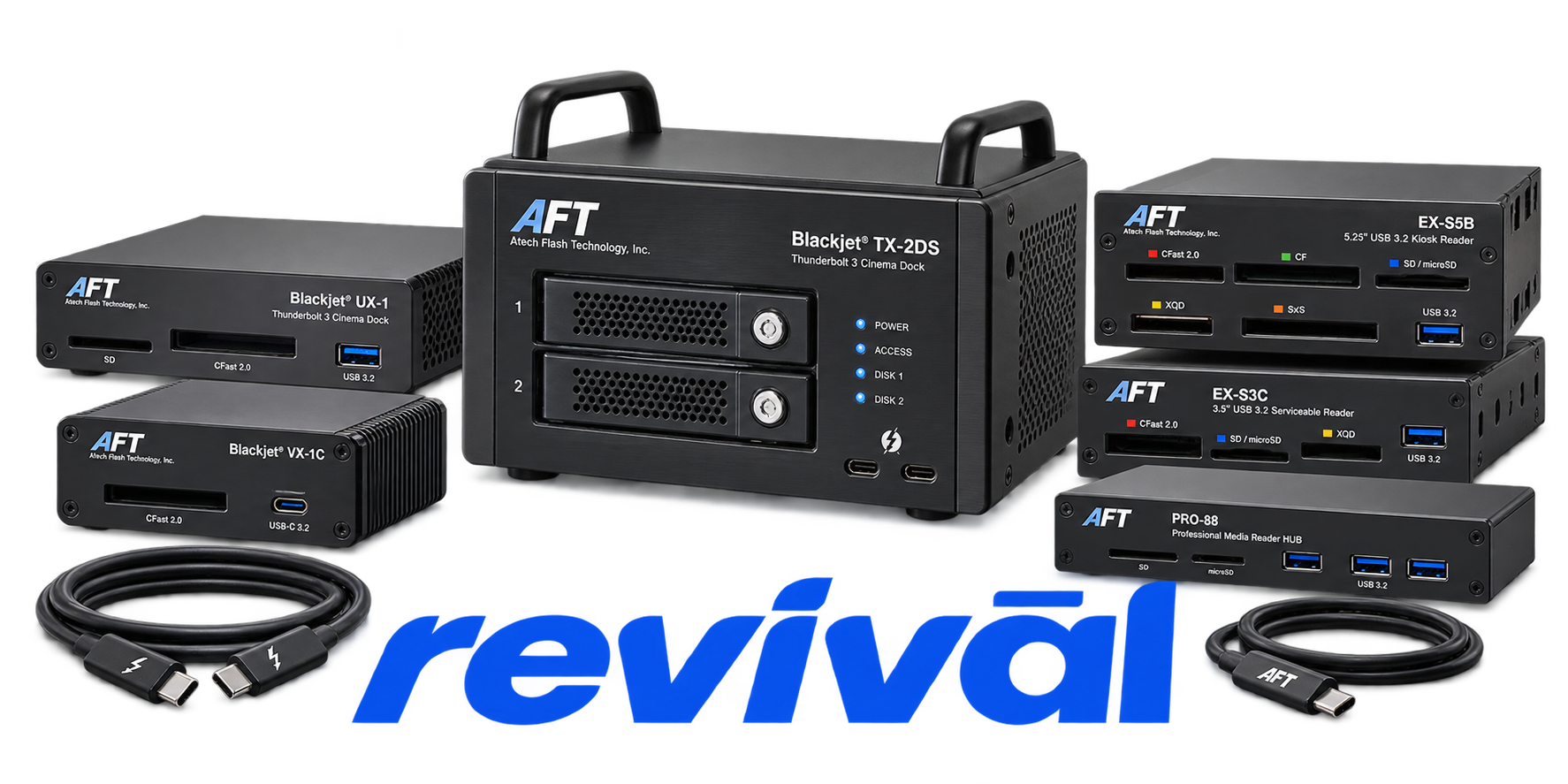
Atech Flash Technology, Inc. is a privately held computer-hardware developer, manufacturer, and OEM/ODM provider specializing in high-speed peripheral and media-ingest products. Its portfolio includes professional flash/media card readers, USB and Thunderbolt devices, RAID/storage systems, professional docking systems, PCIe expansion products, cables, and specialized kiosk readers. AFT has operated in this market for more than 20 years and provides custom OEM/ODM design and manufacturing services to other companies in addition to selling products under its own brands, notably Blackjet. The company is particularly associated with professional and industrial media-card readers, including serviceable readers for photo kiosks and high-speed CFexpress/XQD readers for professional photo/video workflows. Its U.S. operation is in Fremont, California, while available product-origin and trade evidence indicates that a significant part of its manufacturing supply chain is based in Taiwan.

2 Most Seen Failures:

[Memory card not recognized or unreadable]

AFT readers may detect a memory card but fail to mount, open, or read it because of card capacity, firmware, card-manufacturer, or format compatibility issues. AFT itself warns that media compatibility varies, and an iDuo firmware update was required to correct a documented 2 GB SD-card problem. :contentReference[oaicite:0]{index=0}


[Intermittent USB or host detection]

A card reader may fail to appear as a drive or intermittently disappear because of its USB connection, host port, cable, or host-system compatibility. A reported Blackjet TX-1CXQ case showed a card failing to appear until the reader was moved to another USB-C port. :contentReference[oaicite:1]{index=1}

[Card-slot wear or physical connection failure]

Repeated insertion and removal of cards can wear reader mechanisms and connections, particularly in high-use kiosk installations. AFT specifically identifies increased wear and tear as a reason kiosk readers require more frequent servicing and offers replaceable reader modules to reduce downtime. :contentReference[oaicite:2]{index=2}

[Damaged or worn USB/device cables]

Integrated USB, Lightning, or other device cables can become damaged or worn after repeated public or kiosk use, resulting in failed device connections or data transfer. AFT's serviceable kiosk designs explicitly provide replaceable Smart Cables for this failure mode. :contentReference[oaicite:3]{index=3}

[USB performance falls back to a slower mode]

Some AFT readers can connect through a non-high-speed USB hub or unsuitable connection and operate below their intended transfer speed. The XM-35U documentation specifically describes the host reporting a high-speed USB device connected through a non-high-speed hub. :contentReference[oaicite:4]{index=4}

[Unit does not power on or respond]

AFT electronic hardware can appear completely unresponsive when its power connection, AC adapter, wall outlet, or rechargeable battery is unavailable or insufficient. The iCarta troubleshooting documentation lists these conditions for the "no power" failure symptom. :contentReference[oaicite:5]{index=5}

[Docked device not detected or responsive]

Dock-equipped AFT hardware may fail to communicate with a connected iPod/device because of an obstructed or poorly seated dock connector, outdated device software, or a frozen device. Removing the device, inspecting the connector, and redocking it are documented troubleshooting steps. :contentReference[oaicite:6]{index=6}

[Connected device fails to charge]

A docked device may operate incorrectly or fail to charge when it is not seated properly in the connector; some device variants are also unsupported for charging. AFT's iCarta documentation specifically identifies improper docking as a cause of charging failure. :contentReference[oaicite:7]{index=7}

[Excessive heat during extended operation]

Some powered AFT consumer hardware becomes noticeably warm after extended operation, especially at high output levels. The iCarta manual documents this condition and recommends reducing the volume or switching the unit off temporarily. :contentReference[oaicite:8]{index=8}

1 Acme Revival offers repair, service, and part rebuild opportunities for most Atech Flash devices.

Connect with a technician.

  1. 1 Repairs are performed on a best-effort basis. Acme Revival utilizes a network of sophisticated technicians and engineers with diverse service offerings; despite this, factors that influence the repair outcome may ultimately prove unsuccessful. Acme Revival makes no claim that it can, guarantee a repair before your device is sent in for diagnostic evaluation; even then, repair and diagnostic work are not mutually exclusive. Despite well-intentioned quoting, repairs may still prove unsuccessful.
  2. 2 Per information known, researched and collected by Acme Revival and its systems at time of page publishing (September 22, 2026).
  3. *Information regarding this manufacturer/brand/organization is estimated with information collected and known to Acme Revival. This information is intended to provide insights into the spotlight entity, however may not be accurate— information is strictly of estimate nature only.
  4. **The model list shown here may not be an all-inclusive list of the EcoFlow product range. Model list has been derived per information known, researched and collected by Acme Revival and its systems for the US market.