Power Supply Failure
Device will not power on, unexpectedly shuts down, or shows a power-supply alarm. Internal or external power supplies can fail from component aging, electrical surges, or prolonged thermal stress.

Acme Revival is an independent repair network that operates separately from the manufacturers whose devices we service. Our independence enables a repair model that exists beyond manufacturer-controlled strategies, while preserving the ability to work with manufacturers where appropriate.
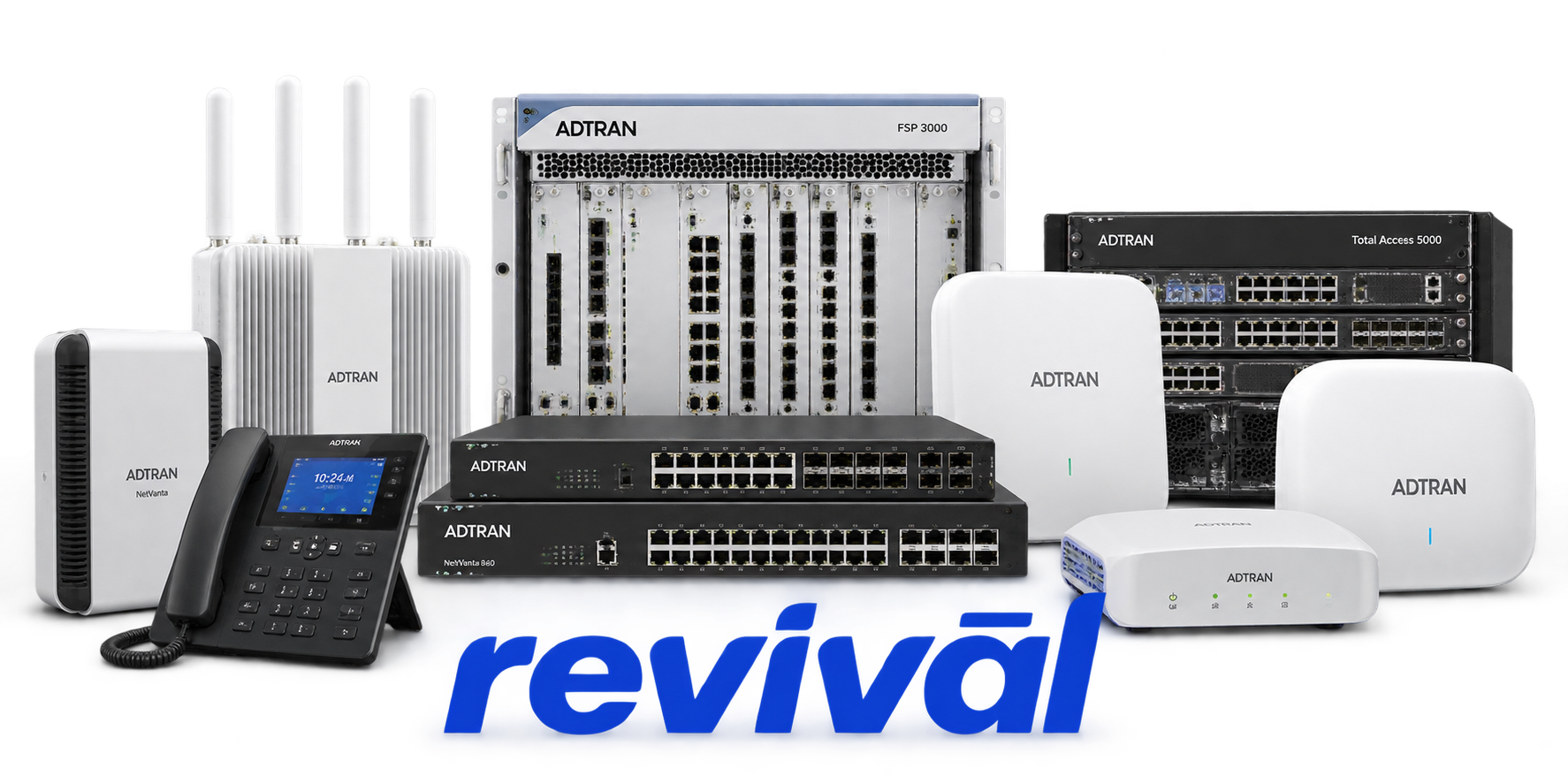
ADTRAN is a U.S.-founded networking and telecommunications equipment manufacturer specializing in broadband access, fiber-optic networking, optical transport, subscriber connectivity, enterprise networking, and network-management software. Its hardware portfolio spans optical line terminals (OLTs), optical network terminals (ONTs), fiber access and aggregation platforms, routers, Ethernet switches, residential and business gateways, Wi-Fi systems, coherent optical equipment, synchronization/timing systems, and network monitoring equipment. Major product families include Total Access, SDX, NetVanta, FSP 3000, FSP 150, SDG, Mosaic, and Intellifi. ADTRAN primarily serves telecommunications and broadband service providers, fiber operators, utilities, enterprises, cloud providers, and government networks, and is particularly known for end-to-end fiber infrastructure extending from the optical network core through access equipment to customer-premises connectivity.
Device will not power on, unexpectedly shuts down, or shows a power-supply alarm. Internal or external power supplies can fail from component aging, electrical surges, or prolonged thermal stress.
One or more RJ45 ports stop establishing a link, intermittently disconnect, or accumulate interface errors despite known-good cabling. Failed PHY circuitry, damaged connectors, or electrical damage to the port are common hardware-level causes.
PoE-equipped NetVanta switches stop delivering power through individual ports or across multiple ports. Failures can involve the PoE power circuitry, port protection components, or overall PoE power subsystem.
Cooling fans can fail or become ineffective, producing fan alarms, excessive internal temperature, abnormal operation, or thermal shutdowns. Dust buildup and worn fan bearings can accelerate the problem in continuously operated equipment.
The unit powers up but fails POST, remains in an abnormal LED state, repeatedly restarts, or cannot complete its normal boot sequence. Flash-storage problems, corrupted firmware, memory faults, or main-board failures can produce this behavior.
Fiber-equipped ONTs, switches, and access equipment lose optical connectivity or report persistent optical/network alarms. Failed optical transmit/receive circuitry, contaminated optical connections, or degraded optical components can prevent a stable link.
WAN, T1, DSX, or other carrier interfaces can develop persistent alarms, loss of link, excessive errors, or complete inability to pass traffic. Interface transceiver circuitry and line-protection components are potential hardware failure points after cabling and provisioning are eliminated.
Total Access and other voice-capable ADTRAN equipment can develop individual analog ports that remain in a fault state or stop providing usable telephone service. Failed line-interface circuitry, surge damage, or damaged port electronics can leave the port defective even after external wiring is disconnected.
Routers, switches, access platforms, and chassis cards can develop board-level faults resulting in dead interfaces, initialization failures, persistent alarms, instability, or complete device failure. Common underlying causes include failed regulators, capacitors, memory, processors, interface ICs, or other board-level power and logic components.
Connect with a technician.

Orders can typically be cancelled 24 hours prior to shipping
Get a real-time offer. Enter the make and model to begin.
Acme offers several ways to pay your service or repair balance.
Securely powered by 
This service is provided by Community Federal Savings Bank (“CFSB”), member FDIC, for which GoCardless Ltd acts as a third-party servicer.
Payable to ACME REVIVAL INC, write ADTRAN in memo line, and mail your check to: 191 University Blvd. Suite 340, Denver, CO 80206. Payment are collected every weekday excluding federal holidays.